
Illinois Projected Versus Actual Release
A projected date is IDOC's current forecast based on the sentence data and credit decisions in its system. The actual date records an event that has occurred. An institutional profile may show a Projected Parole Date for the expected move out of prison. After that move, a profile can show an actual Parole Date and a later Projected Discharge Date. The latter anticipates when the sentence and supervision relationship may end. These fields must not be collapsed into one date.
Pretrial custody works differently. A person awaiting a court decision does not yet have a final sentence from which staff can compute a scheduled release. Bond action, dismissal, a plea, a trial result, another warrant, or transfer can change the custody path. A county-sentenced person may have a local computation that does not appear in the IDOC system. Start with the custodian, then match the date to the court order.
The official IDOC search landing page is the statewide starting point for a sentenced state prisoner.
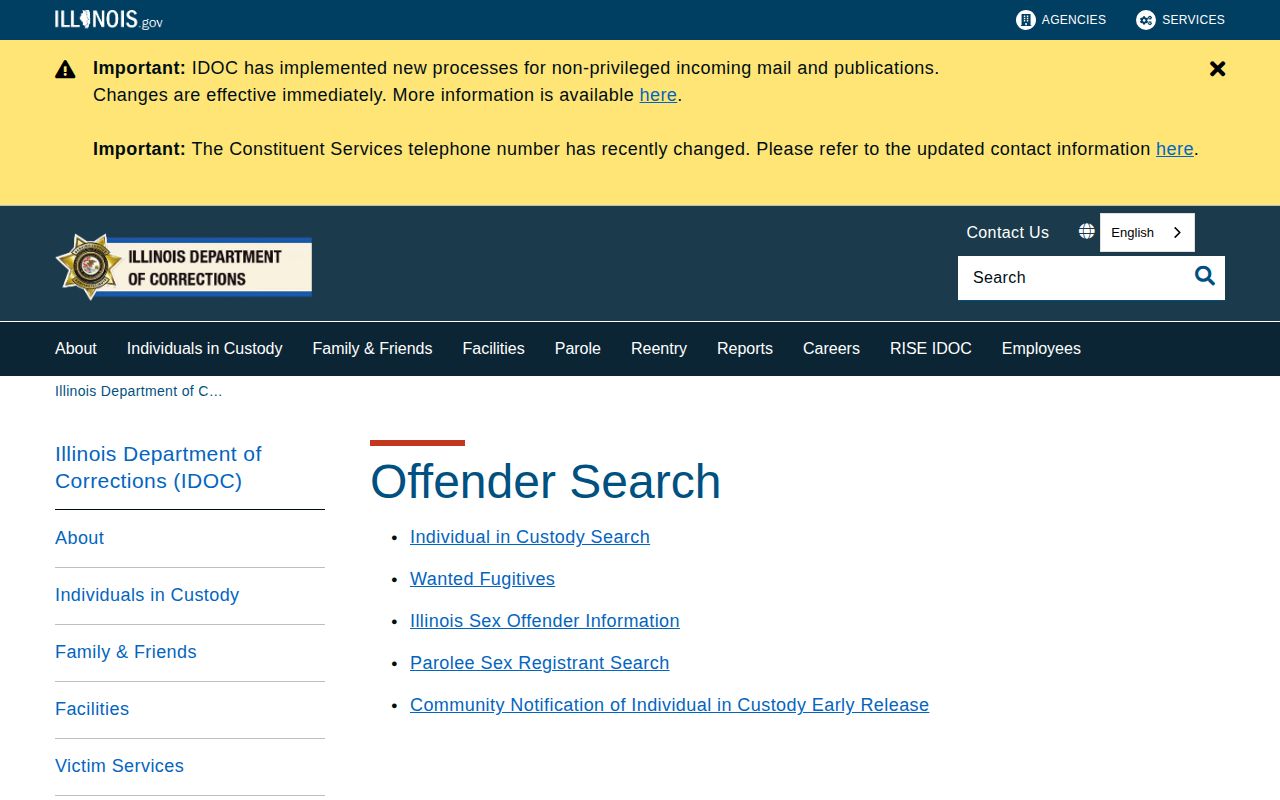
The agency's warning and search entry help keep the lookup tied to the current official record.
Find an Illinois Projected Date
The IDOC application accepts a Last Name, IDOC Number, or Birthdate. Use the correctional number when it is known. It points to one record and reduces common-name errors. When searching by name, compare the result with the birth date, physical description, sentencing county, mittimus or case number, offense, and sentence. A mittimus is the court order that sends the person to corrections.
- Confirm that the person was committed to IDOC rather than held only in a county jail.
- Open the official search and choose IDOC number, last name, or birth date.
- Select the correct profile only after matching several identity and case facts.
- Read Offender Status and Location before interpreting any date.
- Record Projected Parole Date, Parole Date, and Projected Discharge Date as separate fields.
- Compare each sentence row and its discharged YES or NO marker with the court judgment.
The IDOC legacy search form shows all three input routes.
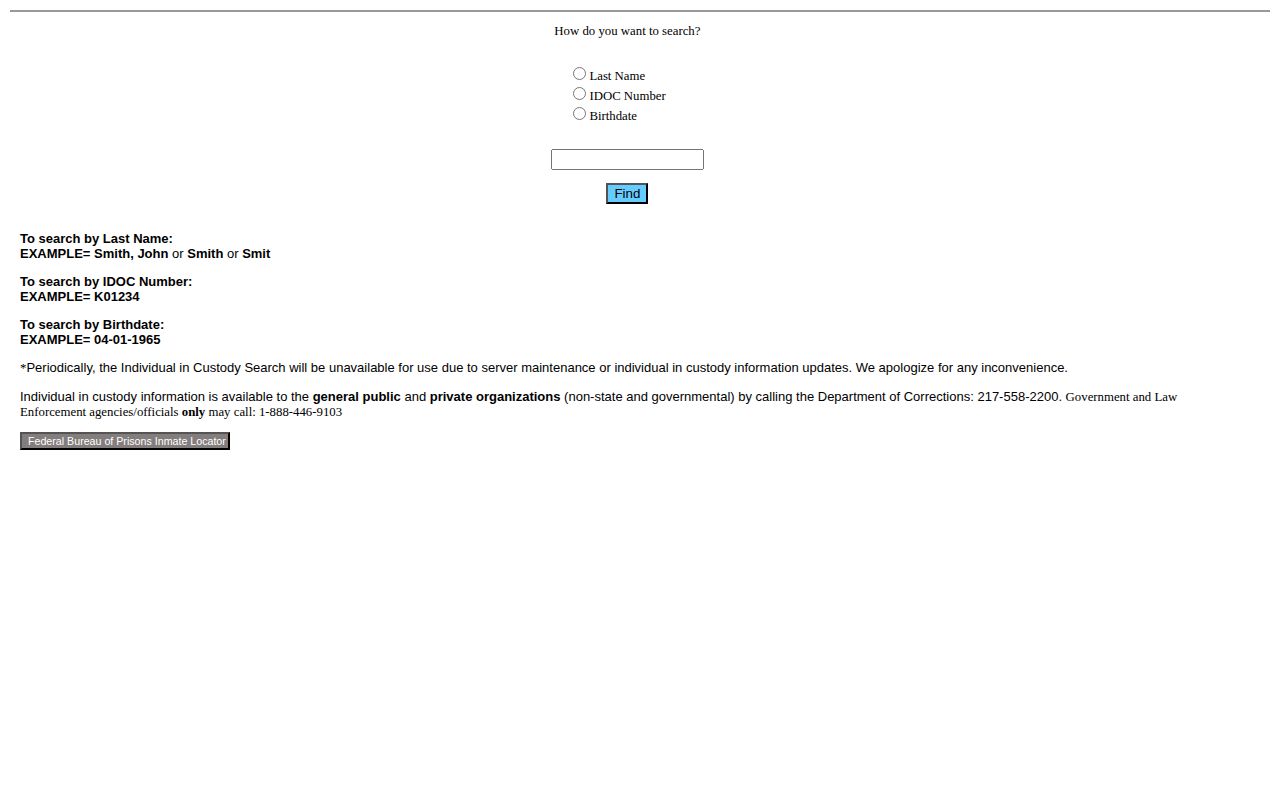
The form supports a broad surname search, but matching facts are still needed before relying on the selected profile.
If the person has only a county-jail history, seek the holding county's release record or sentence computation. A disappearance from a live jail roster can mean community release, transfer to IDOC, movement to another county, or a data refresh. It does not supply a projected state-prison date. The County Directory routes local custody questions to the correct jurisdiction.
Read Illinois Release Date Fields
An IDOC profile can contain several dates because prison exit and sentence discharge are not the same event. First check status and location. IN CUSTODY with an institution points to a current prison placement. PAROLE with a parole-district location can indicate that the person has left the institution for supervision. Illinois statutes usually call the modern release term MSR, but the public interface retains parole wording.
| IDOC field | Meaning | Use |
|---|---|---|
| Projected Parole Date | Current anticipated institutional exit | Quote with an as-of date |
| Parole Date | Recorded move from prison to supervision | Use as the visible actual exit marker |
| Projected Discharge Date | Expected later end of sentence or supervision | Do not present as prison exit |
| Last Paroled Date | A prior-event field that may be blank | Do not infer a fact from a blank |
| Sentence Discharged? | YES or NO for a specific sentence row | Read every count separately |
One sentence row can be discharged while another remains active. That is not a conflict. Each count has its own case, offense, term, and completion status. Check the mittimus number and county against the judgment. If the date must serve as lasting proof, request the agency record or certified court order rather than rely only on a live screen.
Illinois Has No Single Percentage
Illinois good time is not one flat fraction. 730 ILCS 5/3-6-3 ties sentence credit to the offense, offense date, sentence, exclusions, and IDOC decisions. First-degree murder and terrorism under specified provisions receive no sentence credit and require the whole court term. Natural-life imprisonment also receives no credit. Other listed serious offenses cap credit at 4.5 days per month, the rule often described as 85 percent service. Certain serious drug offenses use a 7.5-days-per-month cap, while eligible offenses outside the listed exceptions can use an ordinary day-for-day framework.
The statute also authorizes program credit for qualifying full-time activity. Categories include substance-use programs, correctional industries, education, work release, behavior modification, life skills, and reentry planning. Exclusions apply, and IDOC determines awards. Earned Discretionary Sentence Credit is not guaranteed. IDOC also states that such an award cannot take an 85-percent sentence below its statutory minimum.
| Framework | General effect | Key limit |
|---|---|---|
| Whole-term rules | No sentence credit for specified offenses | Exact conviction and date control |
| 4.5 days per month cap | Often described as about 85 percent service | Only enumerated offenses |
| 7.5 days per month cap | A different restricted-credit tier | Applies to specified serious drug offenses |
| Day for day | One credit day per eligible day served | Exceptions and losses still matter |
| Program credit | May reduce eligible time after an award | Discretionary and subject to exclusions |
This mix is why sentence length alone cannot safely yield an Illinois inmate projected release date. The current IDOC field is the agency calculation. The judgment and the statutory version in force for the offense are the sources for reviewing that calculation.
Concurrent and consecutive sentences add another layer. Concurrent terms run at the same time to the extent ordered, while consecutive terms run in sequence. A profile may list several counts with different custody dates and discharge markers. Reading only the longest-looking term can produce the wrong result. The court's written judgment establishes the structure, and IDOC applies the controlling credit rules to that structure. Later amended orders or corrected mittimus information can require a new calculation.
Illinois Credit Outputs in Context
IDOC's fiscal 2025 report gives scale without creating a person-level formula. It listed 3,978 EDSC exits associated with 271,401 credit days. The same report listed 1,948 GED-completion exits with 364,345 days, 1,352 substance-abuse-program exits with 25,159 days, 3,872 behavior-modification exits with 34,230 days, and 1,980 life-skills exits with 132,936 days.
Those category counts cannot be added into a total number of unique people. One person can occur in more than one program or credit category. Nor does an average derived from statewide totals predict one case. The figures show that credit awards exist at meaningful scale while the governing offense, exclusions, conduct, program completion, and Department action remain individual.
The IDOC annual report archive preserves the source and reporting year.
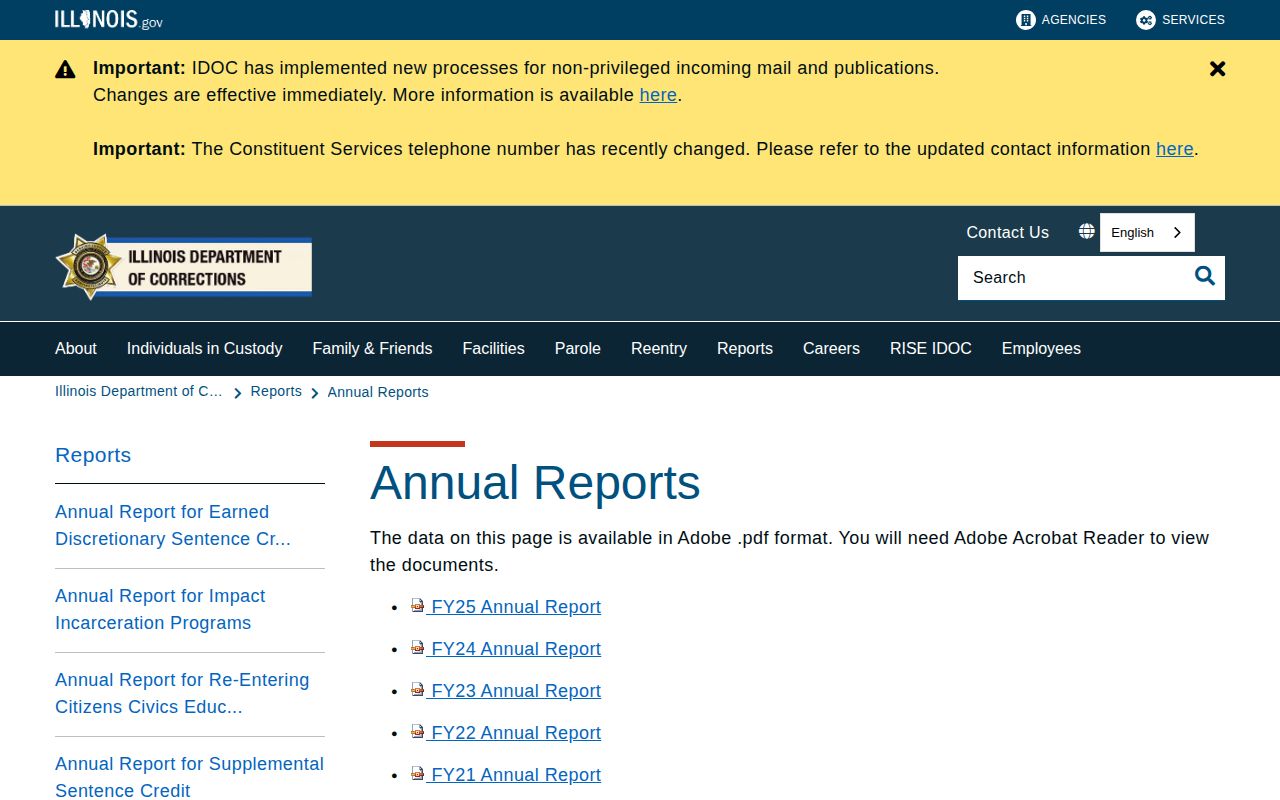
The report should be used for statewide context, not to recalculate a named person's projected release date.
Why Illinois Release Dates Change
IDOC's sentence-calculation directive and FAQ describe a live administrative calculation. A new credit award can move the projected parole date, and the profile should reflect the adjustment. Credit loss, restored credit, missing-time findings, amended judgments, new concurrent or consecutive terms, and corrected sentence data can also change the result. A detainer may affect where someone goes even when the IDOC institutional term ends.
| Event | Possible effect | Verification source |
|---|---|---|
| Earned credit award | May move the projection earlier within legal limits | Current IDOC profile and credit record |
| Disciplinary credit loss | May move the date later | IDOC calculation and disciplinary record |
| New or amended judgment | Can alter the term or count structure | Committing-court order |
| Missing time | Can add time not credited toward the sentence | IDOC sentence calculation |
| Revocation | Can return a person to custody and require a new date | PRB result and revised IDOC profile |
| Detainer or other hold | May change destination rather than the IDOC end date | Holding and receiving agencies |
The Prisoner Review Board hearing page publishes calendars for matters within its authority.
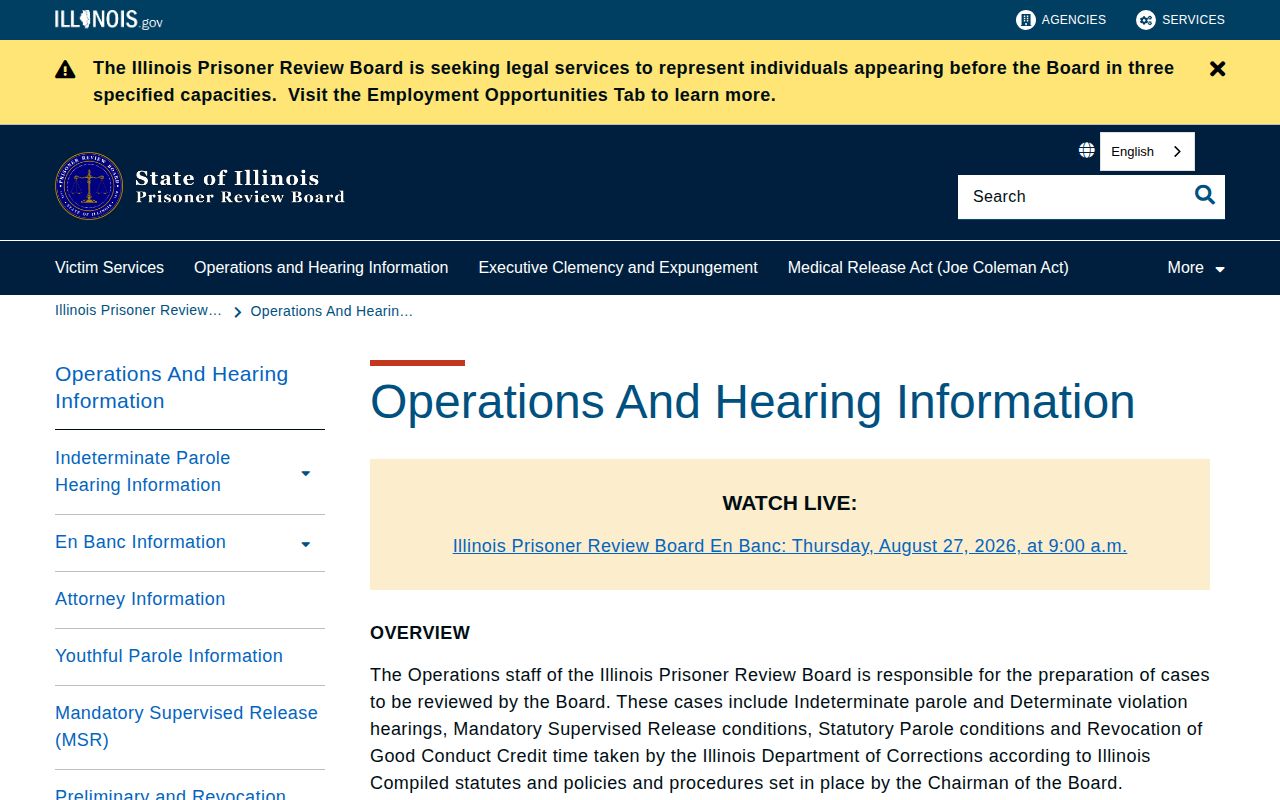
A calendar entry shows that a matter is scheduled. It does not itself prove release, revocation, or a new projected date.
Revocation Resets Release Calculations
A person may leave prison on MSR or parole and later face an alleged violation. A preliminary revocation hearing can end in a violation finding with return to release status under conditions, no violation with return after IDOC approves a plan, or revocation. Only the revocation outcome sends the matter toward reincarceration and a new IDOC calculation. A hearing listing alone cannot establish the result.
Old-law parole decisions and youthful-parole review are separate from the routine projected date on a determinate sentence. People sentenced under the older indeterminate framework may become eligible under 730 ILCS 5/3-3-3. Current youthful-parole law creates review paths for certain people based on age at offense, sentence date, offense, and statutory waiting period. Eligibility for a hearing is not a release date.
Final discharge is later still. The Prisoner Review Board may enter an early final-discharge order when statutory criteria are met. The order ends that specific commitment when entered and is recorded by the committing-court clerk. Until then, an actual Parole Date can coexist with a future Projected Discharge Date.
The fiscal 2025 exit categories also show why the terms matter. IDOC reported 12,392 MSR exits, one parole exit, 3,000 discharge exits, seven court-ordered releases, and 107 deaths. They are event types, not interchangeable dates and not a count of people free from every form of custody. A projected parole field anticipates one kind of institutional exit. It does not forecast final discharge, a court order in another case, or what a receiving agency may do.
Confirm an Illinois Release Date
Check the live IDOC profile again close to the expected day. Record the field name, date, status, location, and capture time. Then compare any changed term with the court judgment. IDOC warns that its public information changes quickly and directs completeness questions to agency staff. When exact proof is needed, request the release, sentence-computation, or discharge record through IDOC Record Search or FOIA.
The IDOC FAQ explains that earned sentence credit can revise the projected parole date and that public profiles stop displaying after sentence completion.
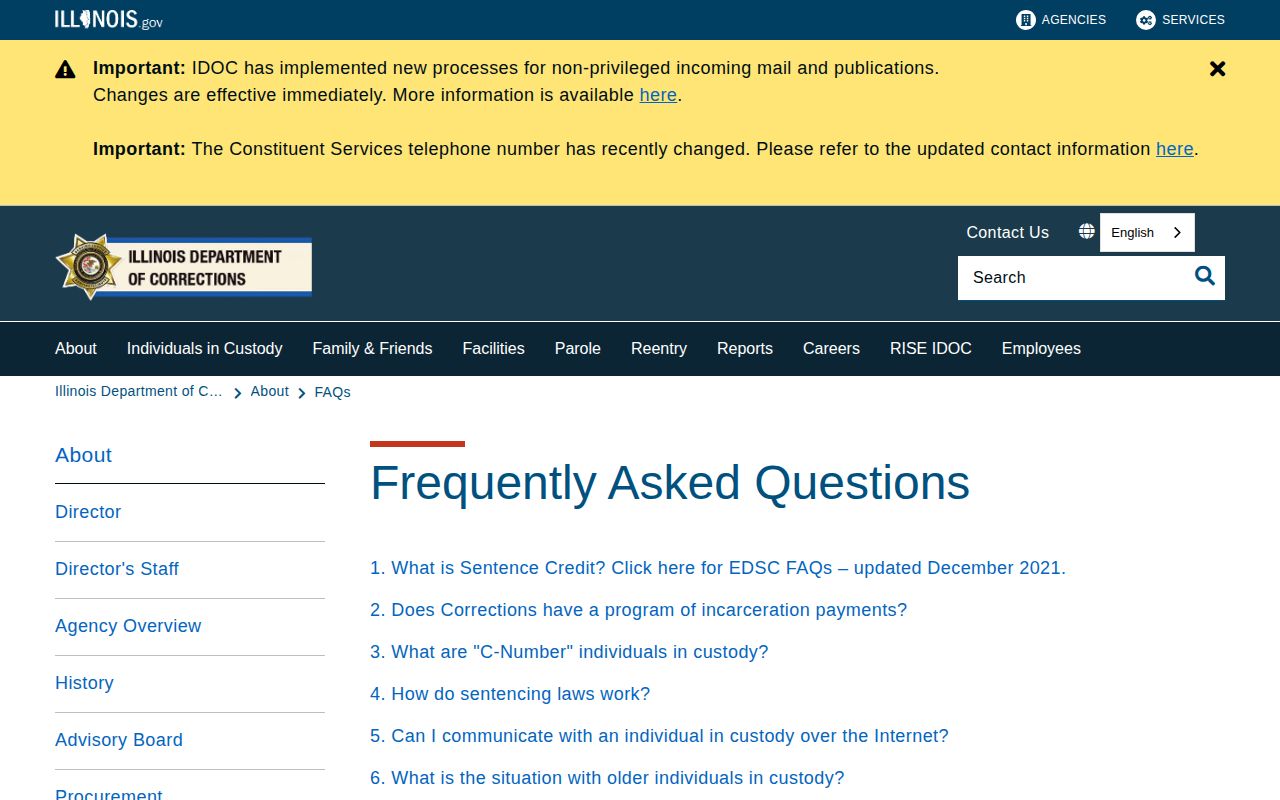
The disappearance rule means an old empty search should lead to Record Search, not to a claim that no IDOC history exists.
Illinois VINE can provide a custody-change alert, but an alert is a prompt to verify the exact date, release type, and destination with IDOC or the source jail. It is not a permanent historical archive. For a federal sentence, use the BOP locator, whose future dates are also projections. ICE's locator covers current immigration custody, not Illinois prison-release history.
For local custody, contact the holding county and sentencing court. For state prison, use IDOC. For an old discharge no longer displayed, request the record. Keeping those systems separate is the most reliable way to answer when an Illinois inmate may be released.
A formal IDOC request should name the person, IDOC number, birth-date details, sentencing county, date range, and exact records sought. Useful terms include sentence computation, earned-credit entry, institutional release date, parole or MSR date, discharge order, and transfer record. Ask for electronic copies and nonexempt portions with redactions. The response can then be compared with the current public profile and the committing court's order.