
Illinois Parole Board Records
The Illinois Prisoner Review Board, commonly called the PRB, handles several distinct matters. Its jurisdiction includes old-law indeterminate parole cases, youthful-parole review, parole and MSR revocations, early-discharge matters, medical release under the Joe Coleman Act, clemency matters, and release conditions. The Board is therefore the source for hearing calendars and specified decision records. IDOC remains the source for a person’s correctional status and recalculated release fields.
A hearing is a process step, not proof of release. A grant or other favorable action may still require an approved plan and later custody processing. A revocation hearing can end with a return to release status, changed conditions, or revocation and a new date calculated by IDOC. Final discharge is a separate action that ends the specific IDOC commitment when the order is entered.
- En banc
- A Board session in which members consider matters as a full panel under its procedures.
- Revocation
- A proceeding on an alleged violation of parole or mandatory supervised release.
- Indeterminate sentence
- An older sentence expressed with a minimum and maximum term, subject to the governing law.
- Mandatory supervised release
- Post-prison supervision for later determinate sentences, often shown as parole in the legacy IDOC interface.
Find Illinois Parole Hearing Dates
The PRB Operations and Hearing Information page posts monthly Board-calendar PDFs. When the research was checked on August 12, 2026, July and August calendars were available, and the page advertised an August 27 en banc livestream. That dated observation shows how the page works, not what will remain posted later. The yearly en banc schedule is a separate source for the full-year meeting pattern.
The official monthly hearing page appears in the captured image. Its calendar links are the right starting point for Board-wide dates and current notices.
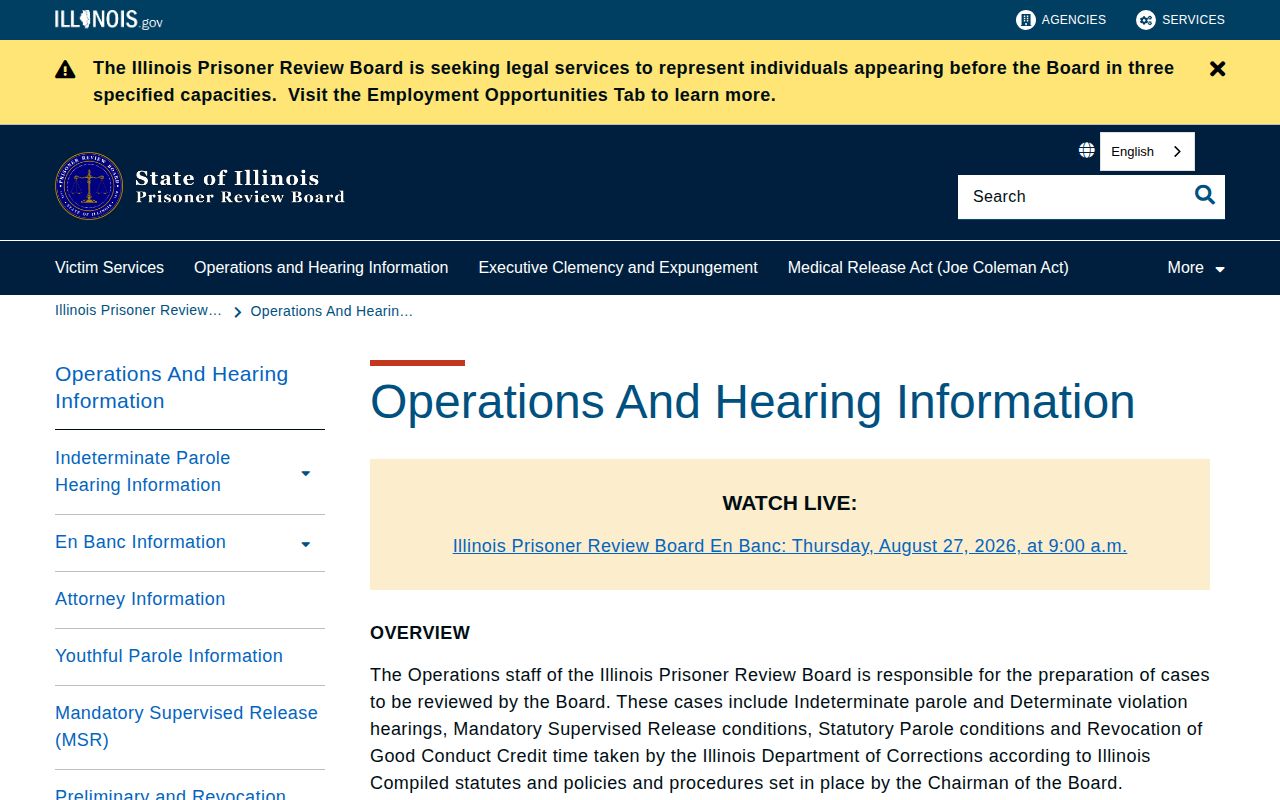
Open the relevant month and record the PDF date. A calendar can change, so return to the live PRB page shortly before the listed session.
- Identify the matter as old-law parole, youthful parole, revocation, early discharge, medical release, or another PRB proceeding.
- Open the monthly hearing page for Board calendars, or the separate revocation schedule for a facility docket.
- Choose the correct month and facility, then inspect the PDF rather than relying on the link label alone.
- Match the person with the IDOC number and other available identifiers.
- Check again near the hearing date because facility dockets may be posted or changed close to the session.
Note: A calendar identifies scheduled Board activity, but it does not establish that the hearing occurred or predict the result.
Illinois Revocation Hearing Dockets
Revocation schedules have their own publication rhythm. PRB says updated dockets are posted during the week before each facility hearing date. A schedule entry may link a docket, remain blank, or say “tickets only.” A blank space cannot be read as a favorable result, a cancellation on the merits, or proof that no case exists. It may simply reflect timing or the kind of matters set for that date.
Facility hearing dockets and Board calendars should be read with the IDOC profile. The IDOC search landing shown here supplies the current custody and parole-status side of that comparison.
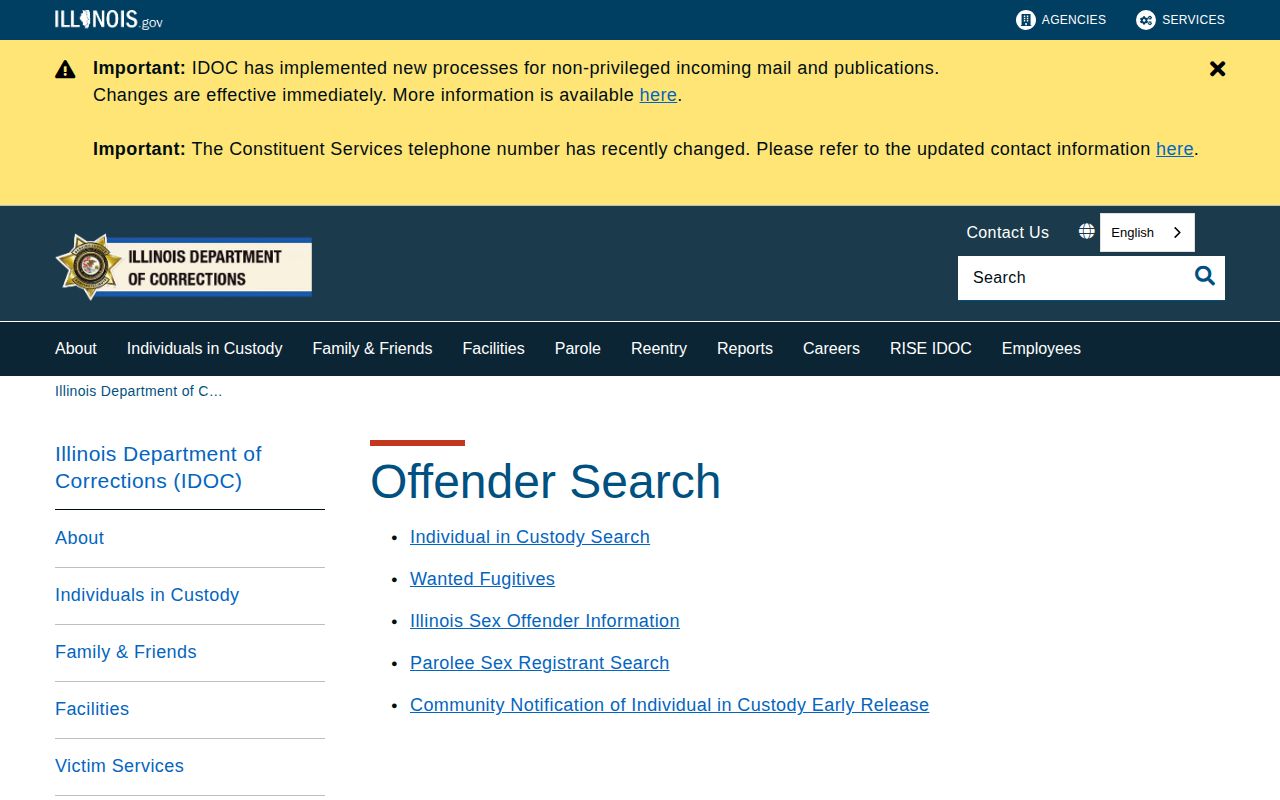
A status shown after the hearing can help orient the reader, but the signed order or result file is the stronger source for what the Board decided.
Find Illinois Parole Decisions
PRB separates current en banc results from revocation results. The current en banc page links the most recently posted document, so any citation should include an as-of date. The revocation-results page is a dated directory. When checked August 12, 2026, it held monthly files for April, May, and June 2026. These are document collections. They are not designed as an evergreen search by a person’s name.
The official revocation-results directory appears in the screenshot. Its month-based structure makes capture dates and later verification essential.
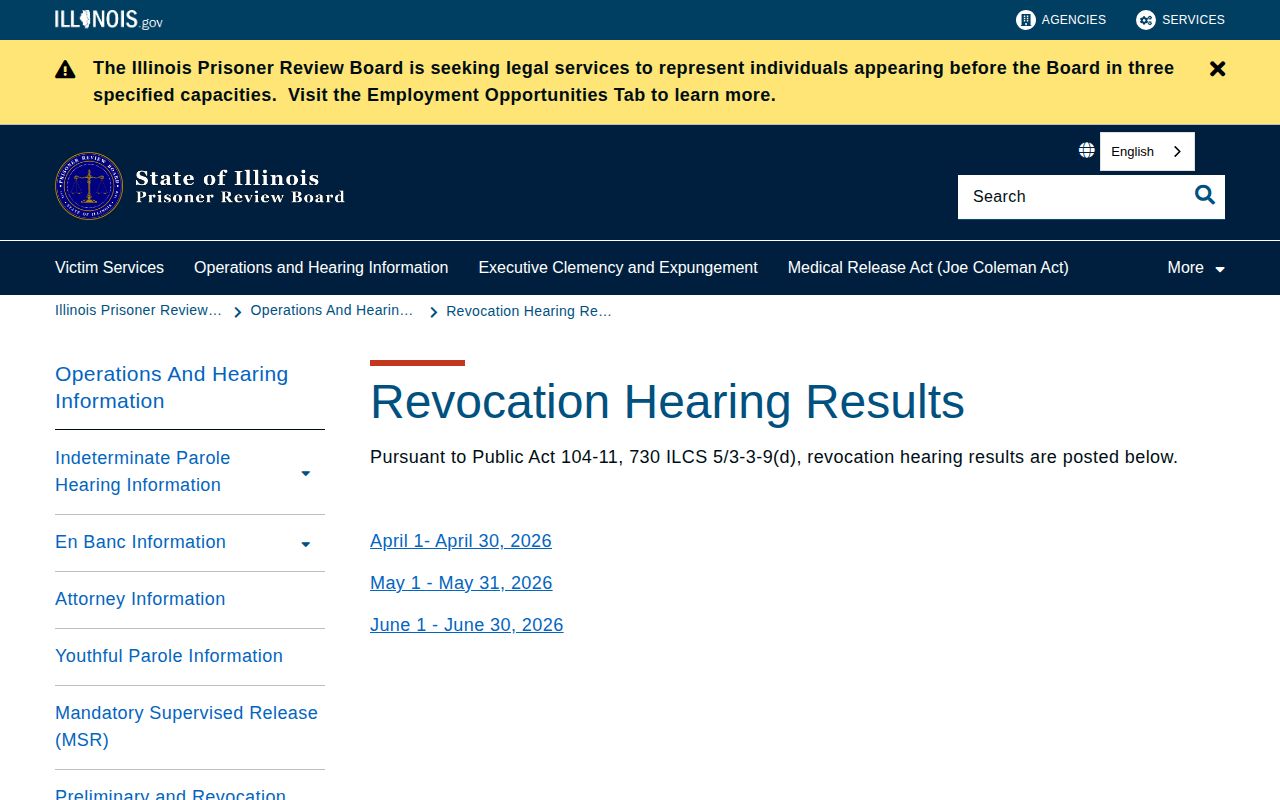
Download the right month, preserve the file date, and compare the entry with later IDOC status information. A result may precede a new release calculation or other processing.
- Open current en banc results for a full-Board decision or revocation results for a violation matter.
- Select the file that matches the hearing month and type.
- Confirm identity with the IDOC number, facility, and hearing context when the document supplies them.
- Read the exact disposition and avoid substituting a general label for the document’s wording.
- Check IDOC and request the written order when proof beyond the posted summary is needed.
Illinois Parole Hearing Outcomes
Illinois hearing outcomes depend on the proceeding. The preliminary revocation page identifies three paths that have very different effects. An old-law or youthful-parole matter follows another decision framework, and a final-discharge matter concerns the end of supervision rather than the first prison exit. Read the case heading before interpreting the outcome language.
| Proceeding or result | What the record means | Next check |
|---|---|---|
| Violation found, return to release | The person may return to parole or MSR, sometimes with new conditions | IDOC status and approved release plan |
| No violation, return to release | The allegation did not result in revocation | IDOC approval of the plan and later status |
| Violation and revocation | Release status is revoked | A new release date calculated by IDOC |
| En banc parole action | The full Board’s posted disposition controls | Current result file, written order, and IDOC profile |
| Final-discharge action | The Board addresses the end of the commitment | Entered PRB order and committing-court record |
The exact result can affect custody, conditions, or the next procedural step. It should not be reduced to “released” or “not released” without the source document and the later correctional record.
Illinois Parole Eligibility Rules
Traditional parole eligibility is mainly an old-law question in Illinois. Under 730 ILCS 5/3-3-3, people sentenced under the pre-1977 amendatory regime generally become eligible through the applicable minimum indeterminate term and credit rules. PRB describes its operational cohort as offenses committed before 1978. People sentenced under the later determinate system generally proceed to MSR after the prison term and credits rather than through traditional discretionary parole.
Youthful parole is a statutory exception. Current 730 ILCS 5/5-4.5-115 generally provides review after 10 years for qualifying people who were under 21 at the offense and sentenced on or after June 1, 2019. Specified offenses have different waits and exclusions, including some 20-year and 40-year rules. A petition may be filed up to three years before eligibility.
Do not calculate eligibility from age and sentence length alone. The offense, sentence date, statutory version, exclusions, credits, and judgment all matter. The PRB youthful-parole guidance and live statute should be checked for the specific case.
Note: A projected IDOC release field and a statutory PRB hearing-eligibility date answer different questions and may not match.
Illinois Revocation Results Trail
Illinois now has a distinct public trail for revocation results. Public Act 104-11 and 730 ILCS 5/3-3-9(d) led to the PRB monthly revocation-results directory, while the facility dockets remain on the schedule page and are updated during the week before a hearing. Together, the two channels help separate the original release from a later alleged violation and its outcome.
The change improves document access but does not create a person-name locator. A search should begin with the hearing type and month, then move to the PDF. Match the result to IDOC status and any later calculation. If the posted set does not include the needed period, request the releasable record from PRB rather than treating absence as proof that no proceeding occurred.
The current en banc results page and the revocation directory update on their own schedules. Save the page and document date because the current destination can change.
Illinois Parole Orders and Records
When a posted calendar or result is not enough, seek the Board record. PRB prefers requests by email to PRB.FOIA@Illinois.gov and accepts mail to its FOIA Officer at 1001 North Walnut Street, Springfield, Illinois 62702. Describe the hearing type, person, IDOC number, facility, approximate date, and the precise order or result sought. Ask for releasable portions if some content is exempt.
The statewide Illinois Courts entry page shown in this capture can help route a reader toward the committing court when an entered discharge order or case record is needed.
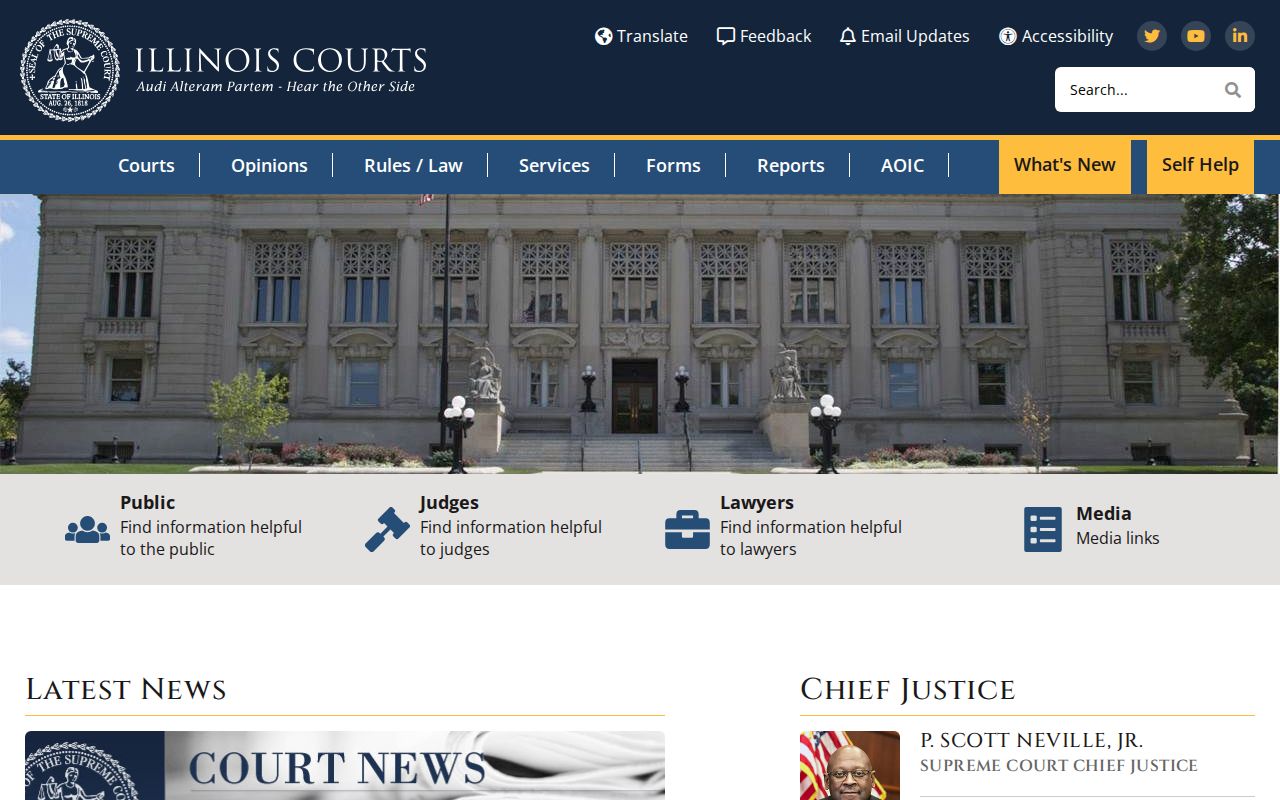
Remote access is not complete for every trial-level record. The local Circuit Clerk remains the dependable source for the committing-court entry.
For the supervision that follows a release decision, use the Illinois Parole & Probation page. The hearing record answers what PRB considered or ordered. The parole record answers the person’s later supervision status.
Illinois Hearing Type Boundaries
Not every PRB matter is a traditional parole hearing. An old-law indeterminate case asks whether the eligible person should receive parole under the governing sentence. A youthful-parole matter applies a later statutory review path to qualifying sentences. A revocation matter asks what should happen after an alleged violation of parole or MSR. Early final discharge addresses whether the remaining supervision commitment should end. Medical release and clemency have still different legal bases.
Clemency is especially easy to confuse with parole. PRB has a role in clemency matters, but natural-life release requires clemency rather than ordinary parole eligibility. A clemency petition and the executive action that may follow do not become a routine monthly parole-calendar result. Check the document heading and statutory route before assigning meaning to a posted date.
Medical release under the Joe Coleman Act also should not be folded into the old-law parole track. The Board’s jurisdiction over several release-related processes explains why its pages contain different calendars, notices, and result sets. The correct search question is not just “Was there a hearing?” It is “What type of Illinois PRB proceeding was set, and which document records the outcome?”
Missing Illinois Hearing Records
A hearing record may be absent from the current web page because the page now points to a newer month, the needed file belongs in another results channel, or the document is not available through that public interface. Search both the schedule and outcome paths. Preserve the exact link text and as-of date for any file that is found.
If the needed document is still missing, submit a focused PRB request. State the person’s full name, IDOC number if known, hearing type, institution, date or month, and whether the request seeks a docket, result, order, or final-discharge record. Illinois FOIA asks requesters to identify records rather than require the agency to answer a legal or factual question. Ask for nonexempt portions if the full document cannot be released.
For final discharge, also check the committing-court clerk because Illinois law directs the clerk to record the sentence and commitment satisfied when the PRB order takes effect. For a later custody status, use IDOC. Each office owns a different part of the record trail, so one missing page should lead to the next source rather than a conclusion about the outcome.
Public Record Search
Sponsored Results