
IDOC Release Search Scope
The Illinois Department of Corrections is the right source when a court committed someone to state prison, a county jail reports a transfer to IDOC, or the last known site was an IDOC prison or Adult Transition Center. The IDOC offender search is not a roll of all people once booked in Illinois. A person whose case ended with pretrial release, dismissal, probation, conditional discharge, or a county sentence may never receive an IDOC profile. That boundary matters because leaving a county roster can mark a move to state prison rather than a return to the community.
IDOC data records milestones, not one simple in-or-out answer. An institutional profile can show IN CUSTODY, a prison location, a Projected Parole Date, and a Projected Discharge Date. A profile for someone who has left the prison gate can show PAROLE, a parole-district location, an actual Parole Date, and a later Projected Discharge Date. Illinois law often calls the modern release form mandatory supervised release, or MSR, even though the legacy public interface uses parole vocabulary.
The official IDOC home page identifies the statewide agency and its public services.
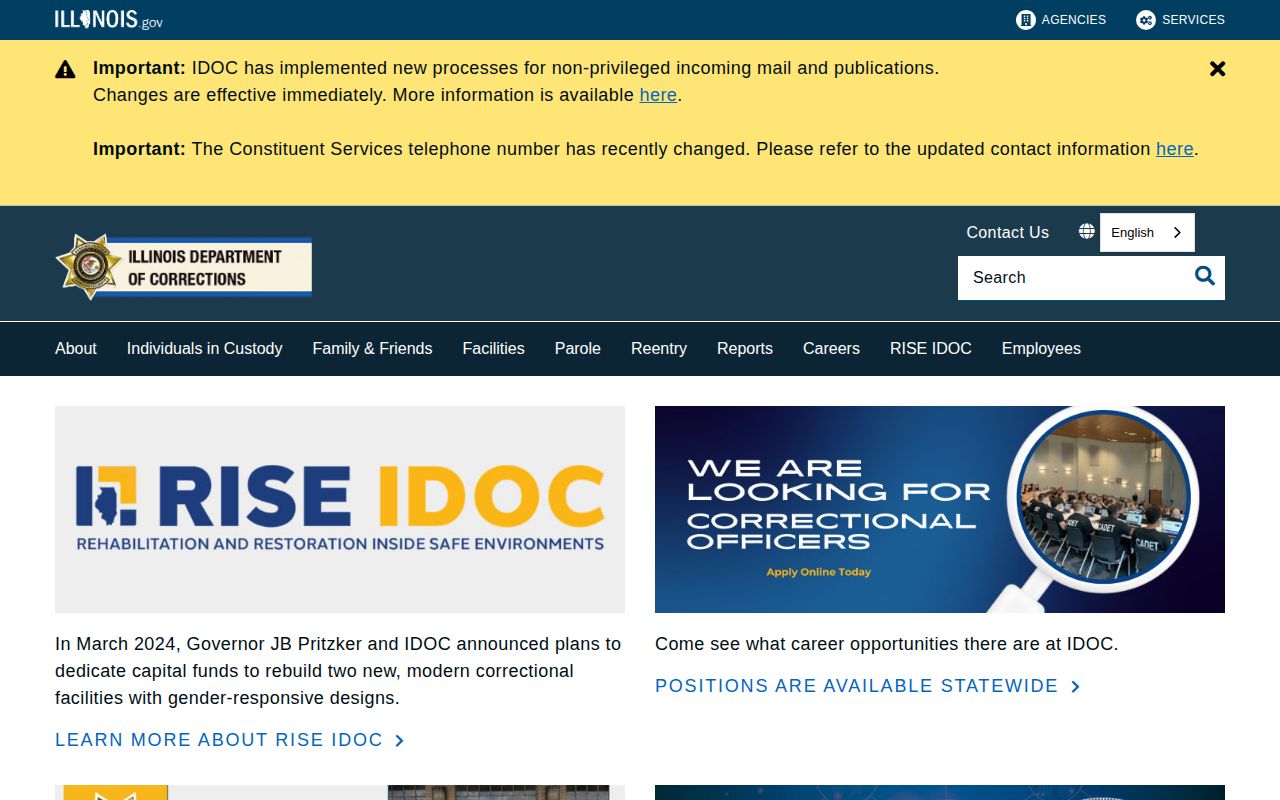
From that agency page, the Individual in Custody Search and records contacts lead to different forms of proof.
Use the IDOC Offender Search
The official application offers three routes: Last Name, IDOC Number, and Birthdate. A correctional number is the best key because it ties the search to one IDOC record. The form accepts a surname alone, a partial surname, or a surname and given name. Its published examples also show an IDOC number in letter-and-digit form and a birth date entered with month, day, and year. Search broadly first, then narrow with facts already known.
- Open the official Individual in Custody Search and accept its terms.
- Choose IDOC number when known. Otherwise use a last name or birth date.
- Compare the result list by full name, birth date, and IDOC number.
- Open the profile and read Offender Status and Location before any date.
- Compare sentencing county, case number, offense, and sentence rows with the court record.
The legacy IDOC search form displays these three search paths directly.
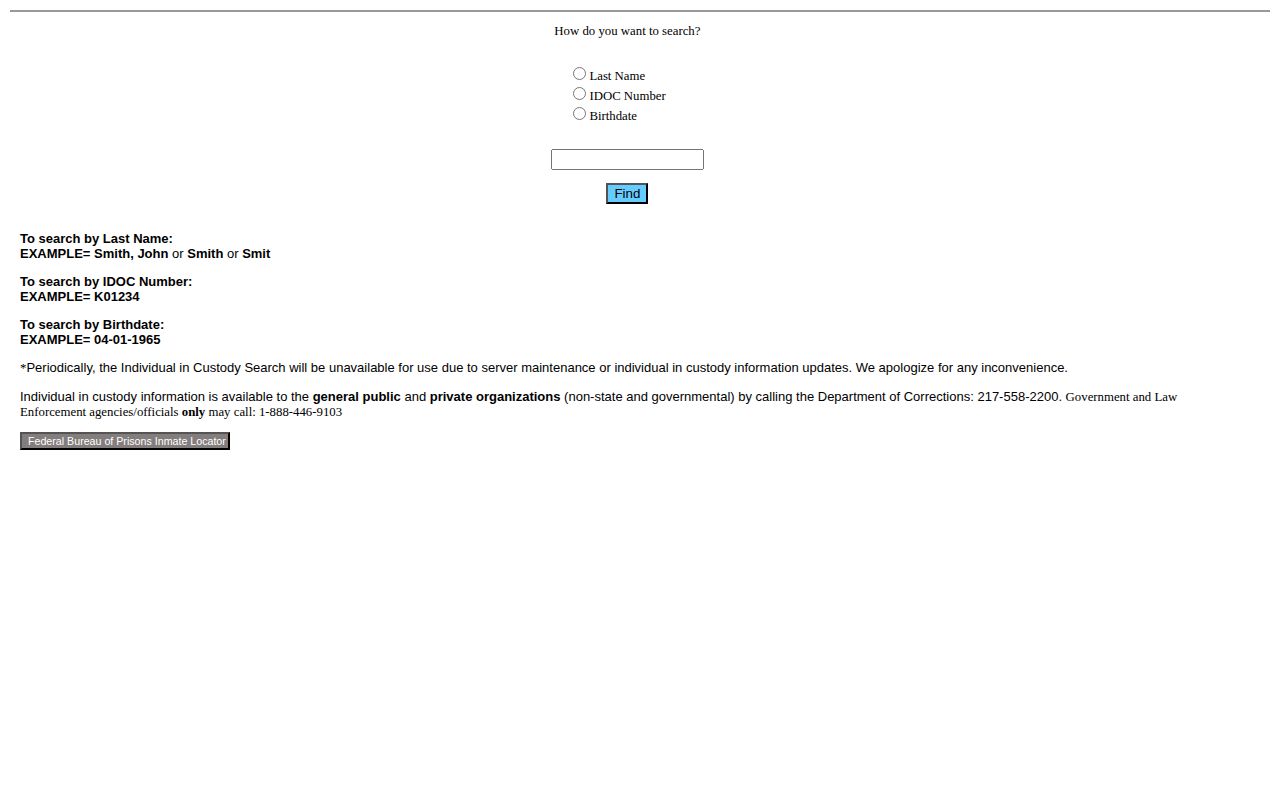
These routes help separate common-name matches before a user relies on a release or discharge field.
A name match alone is weak evidence. Verify the physical description, custody date, mittimus or case number, sentencing county, count, offense, and sentence. A mittimus is the court order that commits a person to corrections. Profiles may contain several sentence rows. One row can say SENTENCE DISCHARGED?: YES while another active count says NO, so the record must be read count by count.
IDOC Released-Inmate Record Fields
The admission, release, and discharge block separates the anticipated prison exit from the later end of the sentence. Those dates answer different questions. The sentence section then links each count to a county case and indicates whether that count has discharged. Capture the profile with the date it was viewed because IDOC warns that information can change quickly.
| Field | How to read it |
|---|---|
| Offender Status | IN CUSTODY marks institutional custody; PAROLE can mark release to community supervision. |
| Location | A prison identifies institutional placement; a parole district indicates the public supervision label. |
| Projected Parole Date | IDOC's current estimate of institutional exit, not a guarantee. |
| Parole Date | The recorded move from the institution to supervision in the public interface. |
| Projected Discharge Date | The expected later end of the IDOC sentence or supervision relationship. |
| Sentence Discharged? | A YES or NO answer for each listed sentence count. |
| Mittimus and county | The committing case and court county used to confirm identity and judgment. |
The IDOC Individual in Custody Search landing page explains the official search and its limits.
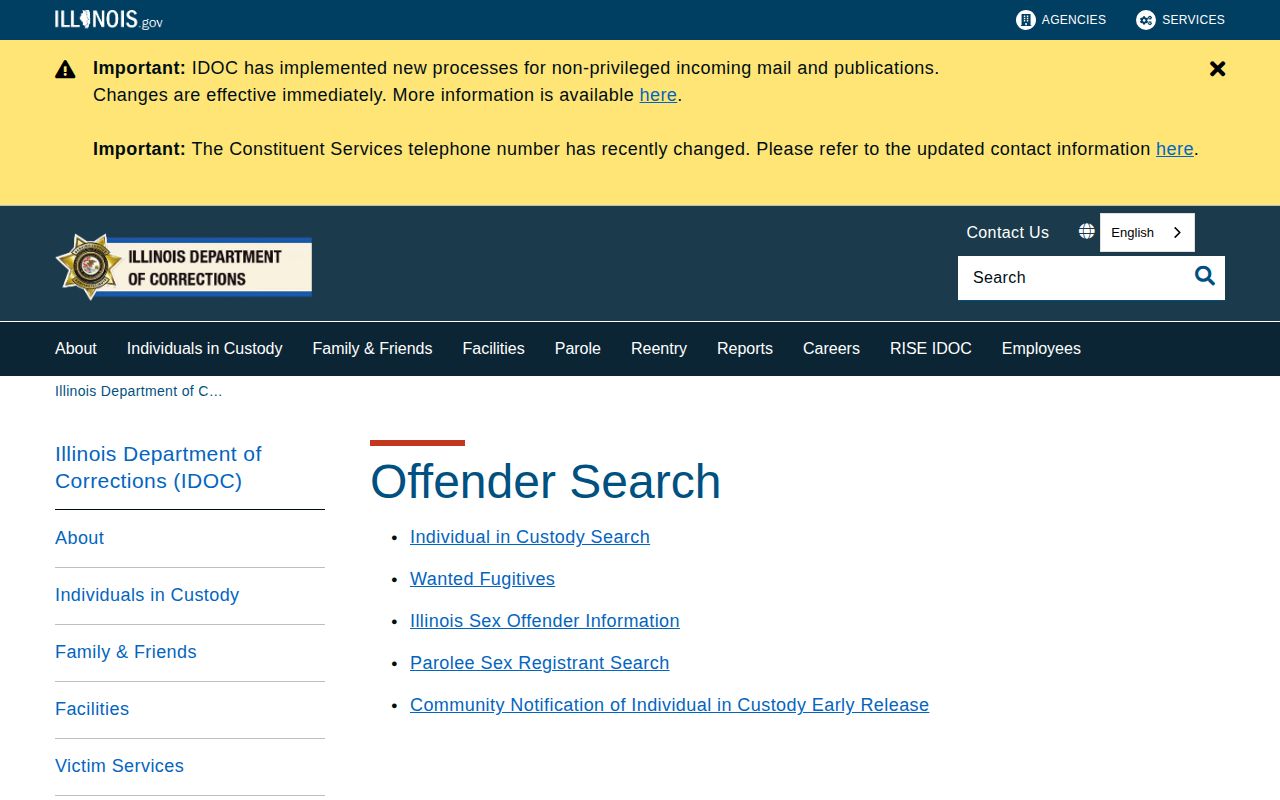
The agency disclaimer is a cue to corroborate a saved profile with the court or a formal IDOC record when durable proof is needed.
Illinois Release and Discharge
Illinois has several distinct exit events. A transfer from a county jail to IDOC ends the local custody episode while incarceration continues. Release from an IDOC prison to MSR or parole ends institutional confinement but normally starts or continues supervision. Final discharge ends that sentence and supervision commitment when the Prisoner Review Board order is entered. Another case, warrant, or custody authority can still apply, so no single field proves that all legal restraint has ended.
The old-law divide explains why terms differ. Traditional parole generally applies to the indeterminate-sentence cohort governed by law before the 1977 change. Most later determinate sentences lead to MSR after the prison term, less lawful credit. The public interface still labels the actual institutional-exit field Parole Date. That label should not be used to suggest that most current exits result from a discretionary parole grant.
MSR length is not one standard term. Current Illinois law includes 12 months for ordinary Class 1 and Class 2 felonies and six months for ordinary Class 3 and Class 4 felonies. Enumerated offenses subject to restricted sentence credit can carry three years for Class X, two years for Class 1 or 2, and one year for Class 3 or 4. Certain offenses have distinct and much longer terms. The sentencing date and the version of the law that governed the judgment control, so the profile and court order are safer than a broad class-based estimate.
The Prisoner Review Board may grant early final discharge when it finds that the person is likely to remain at liberty without another offense. Registered victims receive notice and time to comment under the governing statute. The Board considers risk and needs information, victim statements, compliance, treatment and program progress, public safety, case facts, and the Parole Division recommendation. If granted, discharge takes effect when the order is entered. The clerk of the committing court then records the sentence and commitment as satisfied.
- MSR
- Mandatory supervised release, a period after prison during which IDOC legal custody continues.
- Parole
- Conditional release used for the old-law cohort and as legacy wording in IDOC's public search.
- Final discharge
- The later end of the specific sentence and supervision commitment through an entered order.
- Court-ordered release
- An exit based on a judicial order rather than the standard projected prison date.
Credit rules are also case-specific. Under 730 ILCS 5/3-6-3, some offenses require the whole term, some cap monthly credit at levels often described as 85 or 75 percent service, and other eligible cases use day-for-day credit. Program credit is subject to exclusions and an IDOC decision. The safest practice is to report the current agency date, not rebuild it from the sentence alone.
Illinois Prison Release Logistics
Illinois law does not promise one flat gate-money amount. Under 730 ILCS 5/3-14-1, IDOC must return property held for the person, furnish suitable clothing, and arrange needed transportation upon parole, mandatory release, final discharge, or pardon. The law permits an expense grant in an amount set by the Department. It also calls for voting-rights restoration information and a registration application for an eligible voter released through the listed routes.
IDOC's release directive, effective in 2026, ties travel to the approved host or discharge address. Tickets use the most direct route and may be purchased by a facility business office. Pickup by friends or family can be approved, while staff may arrange a direct bus, train, or staff trip. Requests at or above the policy threshold require added approval. The fiscal directive calls the account gate money, but neither source creates a universal cash promise.
Adult Transition Centers and reentry centers remain IDOC custody settings. Community movement for a program can occur before the Parole Date shown on the profile. A transfer to one of these centers must not be recorded as final release. IDOC also describes reentry summits and a temporary-identification process for people nearing release, with held documents returned at release.
IDOC Release Trends by Type
IDOC's fiscal-year reports show why exit categories should stay separate. Fiscal 2025 recorded 15,507 prison exits, down from 17,442 in fiscal 2024. That is a derived drop of 1,935, or 11.1 percent. Nearly all of the decline sat in MSR: those exits fell by 1,950, while discharge exits changed by only two. A total-release headline would hide that contrast.
| Exit type | FY2024 | FY2025 |
|---|---|---|
| All prison exits | 17,442 | 15,507 |
| MSR | 14,342 | 12,392 |
| Discharge | 2,998 | 3,000 |
| Other FY2025 categories | See annual report | 1 parole, 107 deaths, 7 court-ordered releases |
The IDOC annual-reports archive supplies the dated source files.
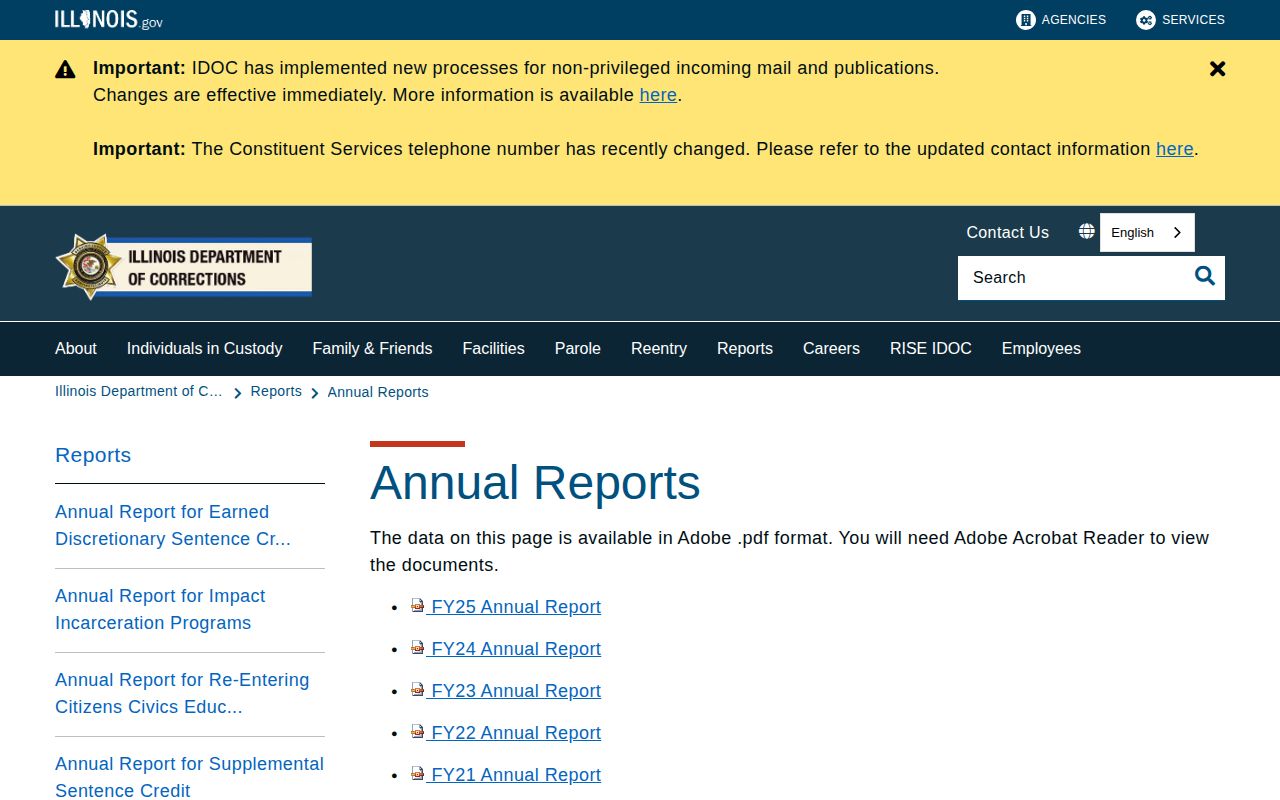
The archive lets a reader preserve the source year and category rather than treat each reported exit as the same event.
The adult parole population also fell from 15,958 at the end of 2024 to 15,372 at the end of 2025. That is a derived decrease of 586, about 3.7 percent. These counts describe people on supervision at set dates. They do not prove an individual profile's status, and they should not be added to annual prison exits.
IDOC Records After Final Discharge
A no-result screen is not proof that no Illinois prison record exists. IDOC's own explanation says a person may not appear because the sentence and parole are complete. The FAQ likewise says public results cover people currently incarcerated or on parole, then stop displaying information after sentence completion. Spelling, maintenance, a jail-only history, and the wrong identifier are other reasons for an empty result.
The IDOC FAQ search-lifecycle explanation states this important limit.
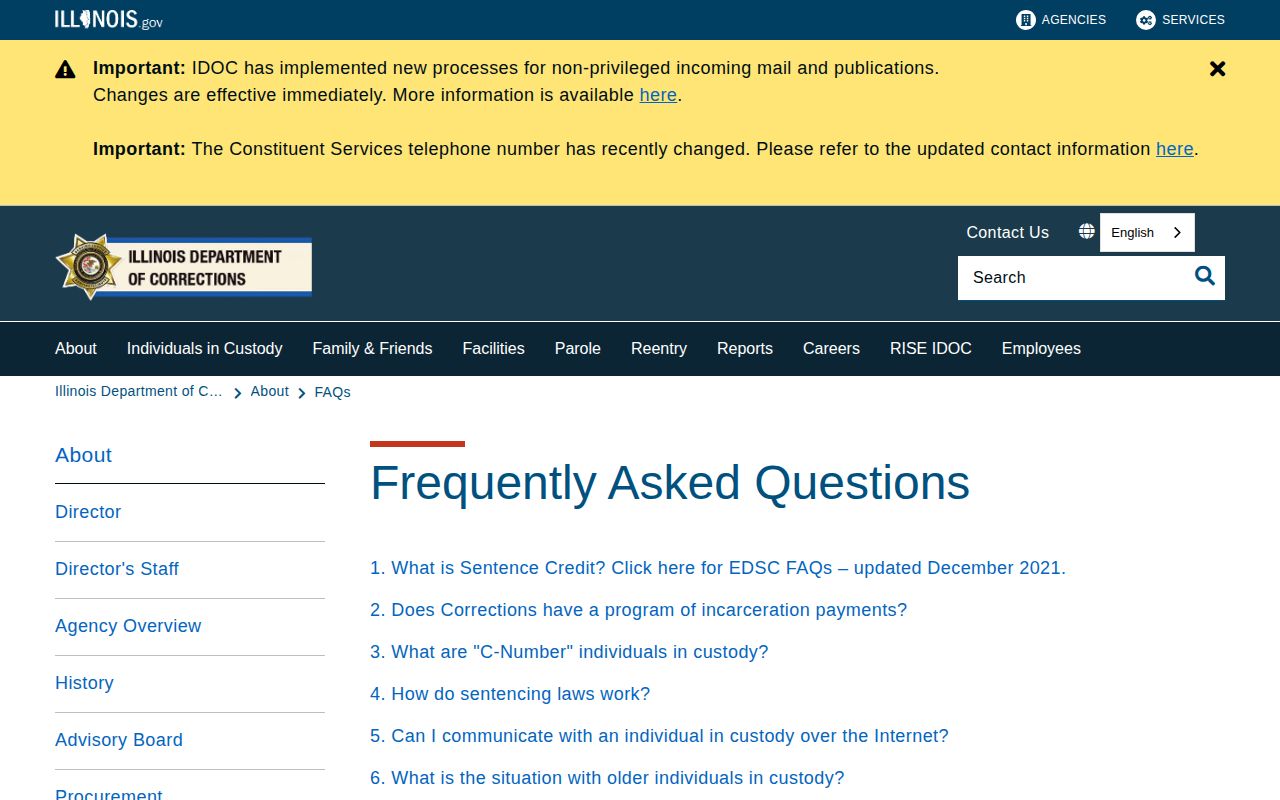
That policy makes the agency's Record Search and FOIA channels part of the normal released-inmate workflow.
For an older final discharge, use IDOC's Contact Us page and choose Record Search. Provide a full name, date of birth, approximate year received, known facility, sentencing county, and relevant dates. Ask for a formal record when the exact status, release date, sentence calculation, or discharge event matters. Keep the original profile capture and note the date viewed, since the public entry can later change or disappear.
IDOC's public profile is also not a substitute for the committing-court docket. The sentence rows expose case-linked facts that can be checked against that court's record, but remote access may be narrower than courthouse access. If a listed count, discharge marker, or custody date conflicts with the judgment, preserve both records and ask the source office to review its own entry. IDOC's FAQ directs record corrections to the agency that supplied the disputed fact rather than treating the public search as self-correcting.
Request IDOC Release Records
Illinois FOIA generally requires a public body to comply with or deny a request within five business days, subject to stated extensions. A good request identifies records instead of asking IDOC to conduct research. Name the custody episode and date range, then request admission, institutional release, parole or MSR, projected or final discharge, sentence-calculation, mittimus, and transfer records as applicable. Ask for nonexempt parts with redactions if a full file cannot be released.
IDOC accepts requests at DOC.FOIARequest@illinois.gov and through its Freedom of Information Act Officer at 1301 Concordia Court, P.O. Box 19277, Springfield, IL 62794-9277. The office lists 217-558-2200 extension 4166 and fax 217-558-5612. Include the full name, IDOC number, enough birth-date detail to distinguish the person, the exact date range, and named records. Electronic delivery can reduce paper costs.
The first 50 standard black-and-white pages are free under the agency's posted schedule. Later pages may cost up to $0.15 each, while other media may be billed at actual reproduction cost. A written denial should state its factual and legal basis and review rights. A Public Access Counselor review request generally must be filed within 60 days with the request and responses attached.
County-jail releases remain with the holding sheriff or local records custodian, not IDOC. Use the Illinois County Directory when the person never entered state prison. For an IDOC release, compare the agency record with the committing-court judgment when a count, date, or discharge term is unclear.
FOIA exemptions can protect personal privacy, an active investigation, safety, confidential sources, law-enforcement methods, and correctional security. Those limits do not mean every corrections record is closed. A narrow request can ask the agency to release nonexempt portions and redact protected details. It can also distinguish an institutional release date from a final-discharge order, which reduces the risk that the office returns a document answering the wrong question.
A requester should retain the sent request, delivery proof, acknowledgment, extension notice, production, and denial. This creates a dated chain for review. When a denial cites an exemption, compare that explanation with the request's wording before seeking Public Access Counselor review. A more precise second request can sometimes isolate the admission, release, transfer, or discharge field without seeking the full institutional file.