
Illinois Released Inmate Records
Release has a narrow first meaning. A person has left one place of custody. That exit may be to the community, but it may also be a transfer to IDOC, another county, federal custody, immigration custody, or a treatment setting. A person released from an IDOC prison to mandatory supervised release, often called MSR, has left the institution while remaining in IDOC legal custody. Final discharge is a later event that ends that sentence and supervision commitment. Another case or custody system may still apply.
The record owner follows the custody system. A sheriff or county jail keeps the local booking and release event. IDOC keeps state-prison admission, sentence, parole-date, and discharge data. The Illinois Prisoner Review Board records certain parole, revocation, and final-discharge actions. Circuit clerks keep court orders and case dispositions. No single Illinois released inmate search merges all these layers. Start with the last confirmed holding agency and preserve the name, date of birth, booking or IDOC number, case number, and dates while they remain visible.
Illinois Release Types Compared
The words used in Illinois records describe distinct events. Bond or pretrial release ends the present jail hold under a court order. Time served follows a sentence or custody period that satisfies the custodial term. A dismissal may remove the case basis for detention. Transfer closes one agency's custody episode while another takes charge. State-prison release to MSR or old-law parole moves a person from an institution to supervision. Final discharge ends the specific IDOC commitment when the proper order is entered.
| Record event | What changed | Best next source |
|---|---|---|
| Bond or pretrial release | The person left county jail under a court process | County jail release record and circuit clerk |
| County time served or dismissal | The local custody basis ended | County records unit and court disposition |
| Transfer | One facility released custody to another agency | Both sending and receiving agencies |
| MSR or parole | The person left an IDOC institution but remains supervised | IDOC profile and PRB records |
| Final discharge | The sentence and supervision commitment ended | IDOC, PRB order, and committing court |
| Federal release | BOP custody ended, though another legal status may follow | BOP locator and federal court record |
Illinois law also separates release from discharge. Under 730 ILCS 5/3-3-8, a person on parole or MSR remains in legal custody until discharge. Read the actual event label instead of treating every departure as the end of all state authority.
Illinois Release Record Fields
County formats differ, yet a useful request can name a common set of fields. Ask for the booking or custody identifier, admission date, release date and time, release reason or type, releasing facility, transfer destination if releasable, and the court case or charge tied to the episode. A county record may also identify the agency that booked the person and the authority for release. Some fields may be redacted under privacy, safety, investigation, or correctional-security rules.
| Field | What it can establish |
|---|---|
| Name and identifier | Which person and custody episode the record concerns |
| Admission or booking date | When that agency took custody |
| Release date and time | When that agency's custody ended |
| Release reason or status | Bond, court order, time served, transfer, parole, or discharge wording |
| Facility or location | Which jail, prison, parole district, or other unit held the record |
| Case or mittimus number | The court record that can confirm the legal basis |
| Projected discharge date | A current expected end point, not the past prison-exit date |
IDOC profiles add key distinctions. An institutional profile may show an admission, a Projected Parole Date, and a Projected Discharge Date. A supervised profile may show `PAROLE`, a parole-district location, an actual Parole Date, and the later projected discharge. Separate sentence rows can show `SENTENCE DISCHARGED?: YES` and `NO` at the same time when one count ended but another remains active.
Request Illinois Release Records
Illinois Freedom of Information Act requests should ask for records, not force an office to research a question. Section 3 ordinarily gives a public body five business days to comply or deny, with extensions only for stated reasons. The first 50 standard black-and-white paper pages are free. A body may then charge up to $0.15 per page, while electronic delivery often avoids paper charges. Corrections exemptions can permit redaction or withholding of protected details, but a request may seek all nonexempt portions.
- Identify the agency that held the person and the exact custody episode. For county custody, use that sheriff or jail records unit.
- Give the full name, date of birth, identifier if known, facility, date range, and case number. Ask for admission, release, status, and discharge fields by name.
- For IDOC, send a narrow request to DOC.FOIARequest@illinois.gov or the IDOC FOIA Officer. Request electronic delivery and releasable portions with redactions.
- Track the response date. A written denial should state its factual basis, legal authority, responsible people, and review rights.
- If needed, seek Public Access Counselor review within the stated review period and attach the request plus all responses.
The governing FOIA response rule explains timing and extensions. Section 7 of the same law addresses privacy, law-enforcement harm, investigations, safety, sources, and correctional security. Sealed, expunged, juvenile, impounded, or confidential material may not appear online or may be unavailable to a general requester. Online display is not the same as agency retention. IDOC may stop publishing a profile after sentence completion while its Record Search and FOIA paths remain the proper routes for an older record. County retention and access must be confirmed with the county that created the release record.
What IDOC Provides at Release
Illinois does not publish one guaranteed flat gate-money amount. Under 730 ILCS 5/3-14-1, IDOC must return held property, provide suitable clothing, and arrange necessary transportation when a person leaves through parole, mandatory release, final discharge, or pardon. The agency may also provide a travel-and-expense grant in an amount it sets. A fiscal directive calls the account gate money, but that label is not proof of a fixed payment.
The release directive effective in 2026 gives practical detail. Travel uses the approved host or discharge address. Tickets follow a direct route and may be bought through the facility business office. Pickup by friends or family may be used. Staff may instead select bus, train, or agency transport. Adult Transition Centers remain IDOC custody settings, so movement into the community from one does not by itself prove the Parole Date has occurred.
The PRB hearing information page displays the monthly calendar route for matters within the Board's authority.
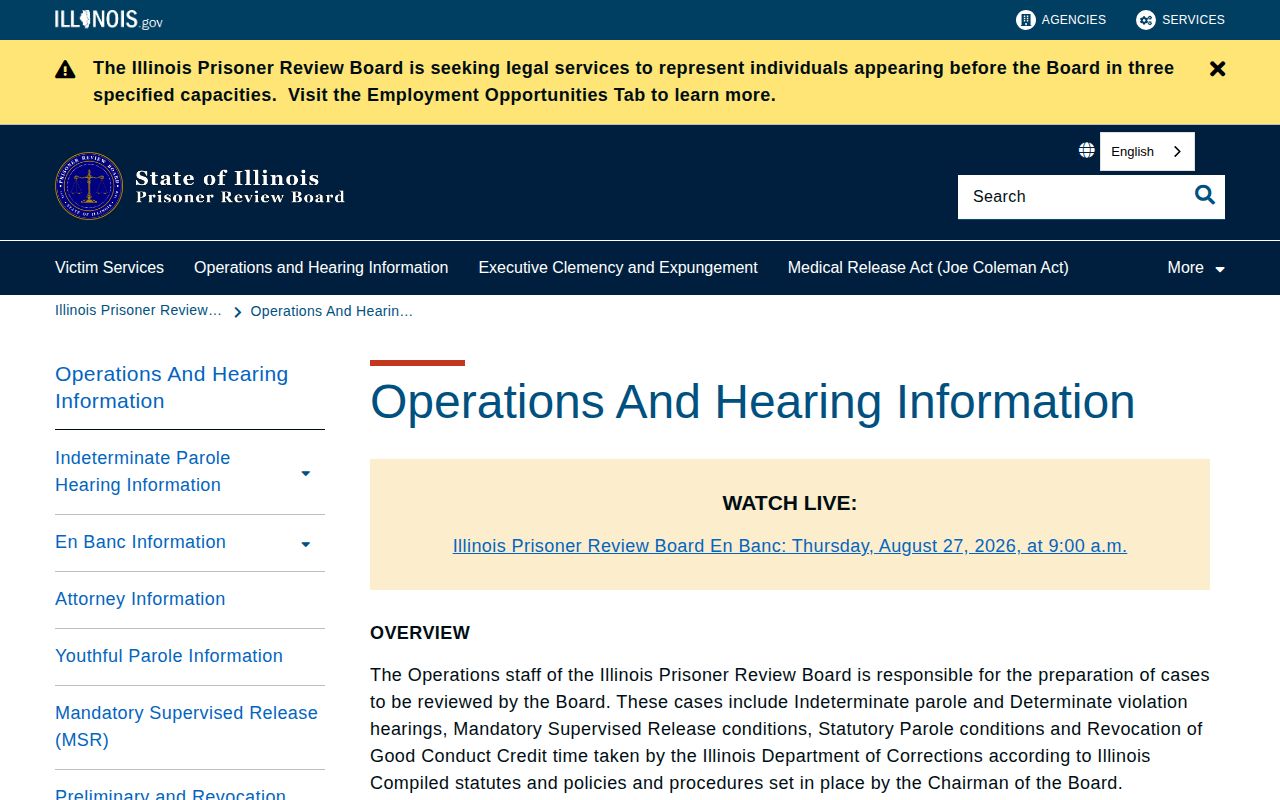
A calendar entry should be read with the later decision or agency record because a scheduled hearing alone does not establish release or discharge.
Illinois Prison Release Trends
IDOC reported 15,507 prison exits in fiscal year 2025, down from 17,442 in fiscal year 2024. That was a derived drop of 1,935 exits, or 11.1%. The change was concentrated in MSR exits, which fell from 14,342 to 12,392. Discharge exits were almost flat, moving from 2,998 to 3,000. The contrast matters. “Exit” groups events that do not all end legal custody, while discharge is the later endpoint for a sentence commitment.
The adult parole population also declined, from 15,958 at the end of 2024 to 15,372 at the end of 2025. That was a derived reduction of 586, about 3.7%. These statewide counts describe agency events and populations, not a searchable list of unique Illinois released inmates.
IDOC posts the source documents through its annual reports page.
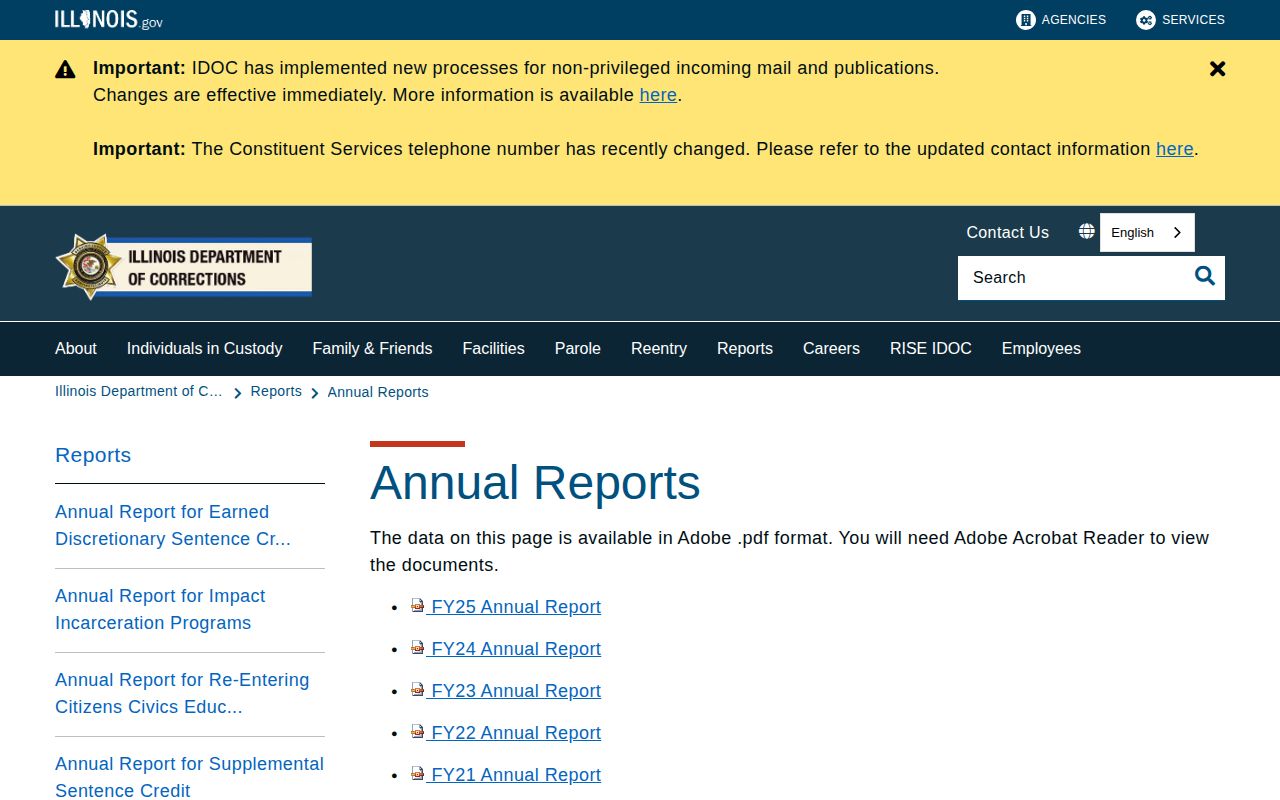
The dated reports let a reader keep statewide totals separate from a named person's live profile.
Find Illinois Released Inmates
The best search order starts with the custody system, not the person's home address. A county roster covers people held by that jail now. IDOC covers current state prisoners and people shown on parole, not every person ever booked in Illinois. The court file can show the order that led to release. Federal and immigration systems have separate tools. Work from the last confirmed facility and match more than a name.
- If a court committed the person to IDOC, search by IDOC number when known. Otherwise use surname or birth date and compare the profile identifiers.
- If the episode stayed local, identify the holding county. Check its release record and circuit-clerk case rather than relying on the current jail roster.
- If the person vanished from one roster, test transfer paths. Check IDOC, the host jail used by that county, and any known receiving agency.
- For federal custody, use the BOP locator. For current immigration custody, use ICE ODLS with the exact required identifiers.
- Use VINE for status and notice, then confirm the exact date, type, and destination with the agency that supplied the data.
Save the source agency name and an as-of date with each result. A projected date, an alert, and an agency release record answer different questions and should not be merged into one claim.
Roster limit: An absent name does not prove community release. It can reflect transfer, a data refresh, another custody system, or an identifier mismatch.
IDOC Released Inmate Search
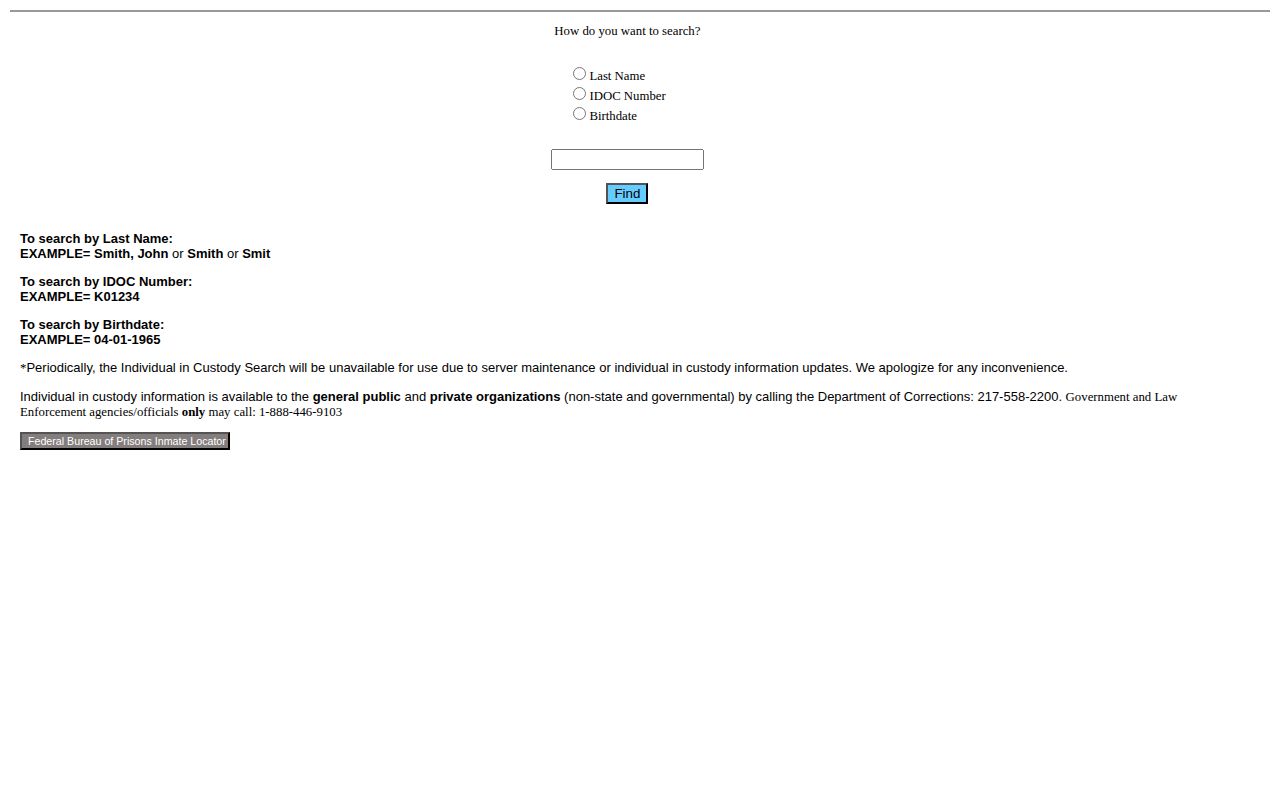
The IDOC application offers Last Name, IDOC Number, and Birthdate routes. Its examples allow a full name, surname-only, or partial-surname search. Results first expose the name, IDOC number, and birth date. Open the matching profile, then read Offender Status and Location before reading any date. The IDOC number is the strongest single key, but date of birth, physical description, sentencing county, case or mittimus number, offense, and sentence facts should support the match. The IDOC Individual in Custody Search landing page introduces the official search and warns that information can change.
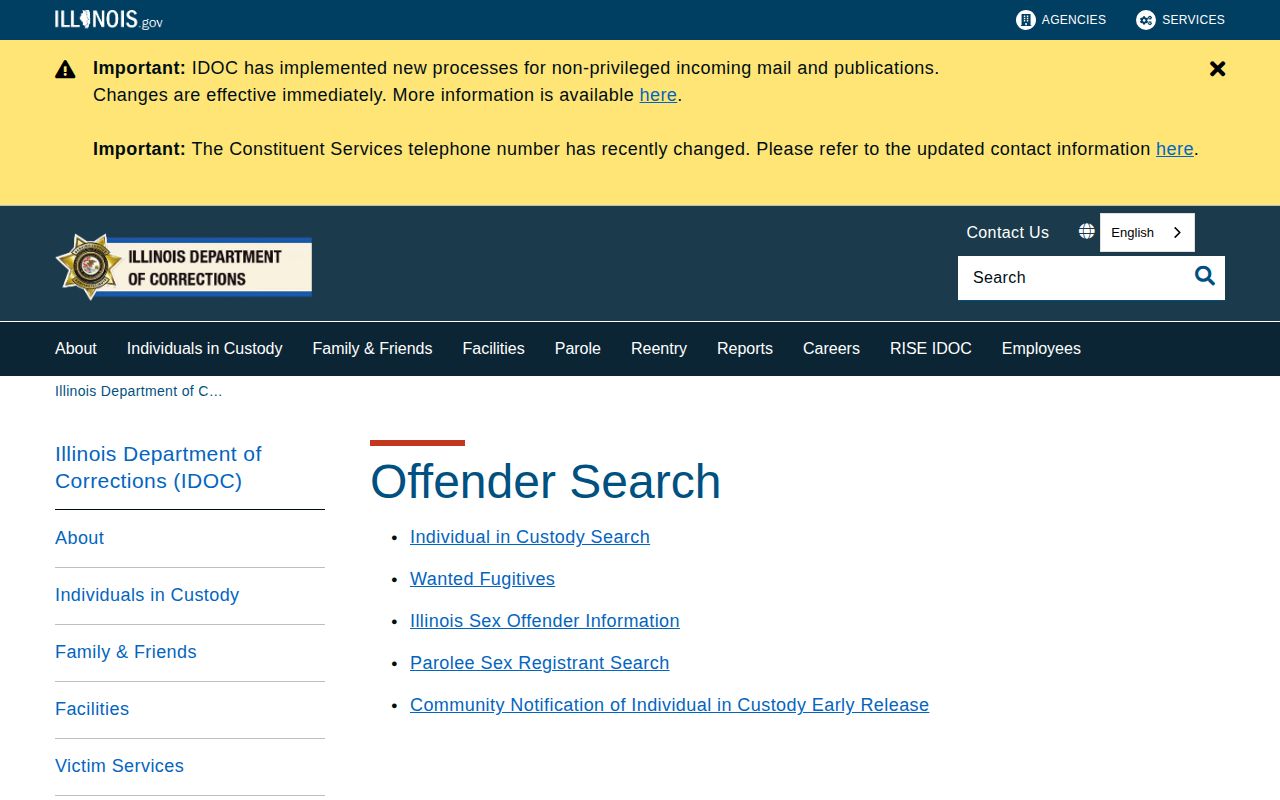
The landing page routes to a legacy form whose field labels remain central to matching a released state prisoner.
| Search field | How to use it | Match check |
|---|---|---|
| Last Name | Full, surname-only, or partial surname route | Compare birth date and IDOC number |
| IDOC Number | Enter the correctional identifier | Best direct link to one profile |
| Birthdate | Use the form's month-day-year format | Compare name, county, and sentence facts |
The official legacy IDOC form visibly separates the three search methods.
Once a profile opens, Parole Date is the recorded institution-exit marker, while Projected Discharge Date points to a later expected endpoint.
Missing Illinois Release Profiles
IDOC says its public results cover people now incarcerated or on parole and stop displaying information after sentence completion. Its no-result text also lists a discharged sentence or completed parole as a reason a person may not be found. Other explanations include spelling, site maintenance, a jail-only history, and a wrong identifier. Thus an empty IDOC result cannot prove there was no Illinois custody record.
For an older or fully discharged record, use IDOC's Record Search contact route or make a focused FOIA request. Give the full name, date of birth, approximate year received, facility if known, sentencing county, IDOC number, and date range. Ask for the admission, release, discharge, and sentence fields needed. An official court order or agency production is more durable than a saved live screen.
The IDOC FAQ source explains why a completed sentence can cause public search information to disappear.
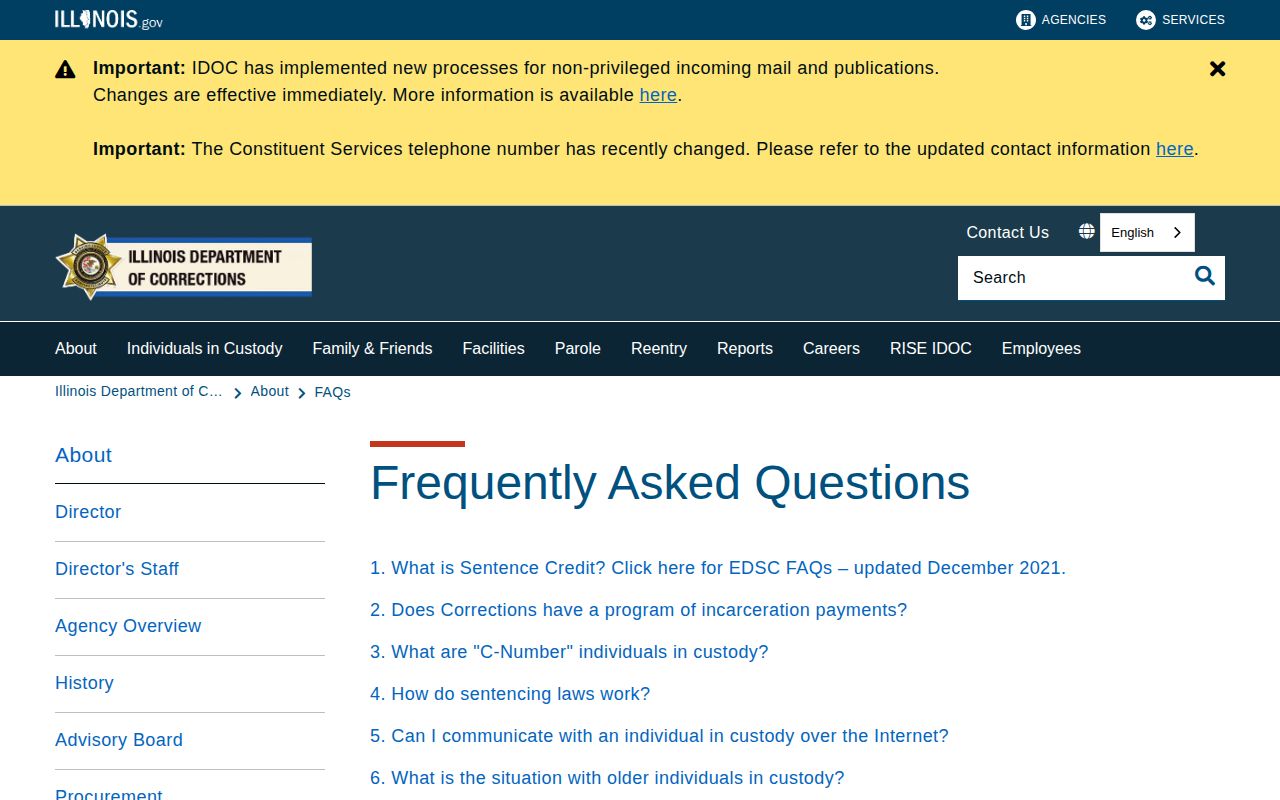
This limitation makes a records request part of the normal Illinois released inmate search, especially for an old final discharge.
Illinois County Release Evidence
Illinois county access varies sharply. Across the 102 county research files, release evidence ranges from frequently refreshed trackers and named online rosters to morning PDF snapshots, vendor interfaces, phone-only checks, and counties that house adults in a neighboring jurisdiction. A live roster is built for current custody. Its update speed, retained fields, and treatment of past bookings depend on the source county.
When one county sends adults to a host jail, disappearance from the sending county's data may reflect transport rather than release. Preserve the booking number, case number, date of birth, arresting agency, and last-seen facility. Then check the host jail and the court file. The county that created the record remains the best place to request its release fields, while the physical host keeps its own custody episode.
Use the Illinois County Directory to route a local jail episode to the correct county site. The county path belongs at the point where local data and host-jail practices affect the search.
Illinois Release Is Not Discharge
A person may leave an IDOC prison on MSR or parole and still appear with `Offender Status: PAROLE` plus a parole-district location. The actual Parole Date marks the move out of the institution. The Projected Discharge Date anticipates the later end of the commitment. Probation is different. It is ordered by a court and administered through circuit-based departments, not through IDOC parole.
- Release
- Exit from one custodial institution or agency.
- MSR
- Mandatory supervised release, the supervised phase that commonly follows a modern Illinois prison term.
- Parole
- The public IDOC interface label and an old-law release form for eligible cases.
- Probation
- A court-ordered status managed through a county or circuit probation department.
- Discharge
- The end of the specific sentence and supervision commitment after the proper order.
PRB may enter an early final-discharge order under the governing law. That order becomes effective on entry, and the committing-court clerk records the sentence and commitment as satisfied. IDOC policy refers to a Discharge Letter, but the research found no public certificate database. Seek a releasable IDOC or PRB record and compare it with the committing court.
The PRB revocation-results directory provides dated result files for a different question: what followed an alleged supervision violation.
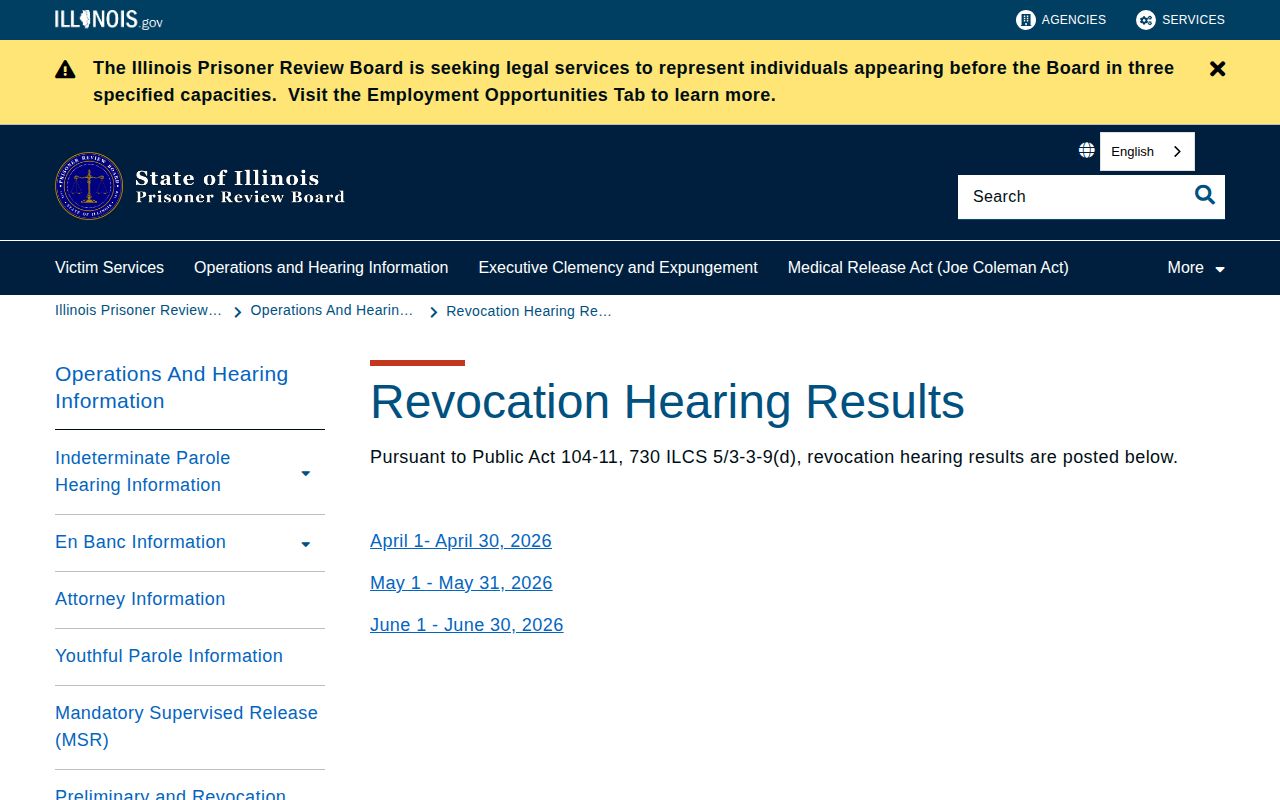
A result can return a person to release status, impose conditions, or revoke release, so it must not be treated as automatic proof of discharge or reincarceration.
Illinois Release Alerts
Illinois VINE links custody and criminal-case feeds from state and participating local sources. Select Illinois, choose custody or court status, search by name or identifier, and match the supplying agency plus identity fields. A matched record can support notice by phone, text, email, or mobile app. VINE is a notice tool, not a permanent archive. Confirm a release alert's exact date, type, and destination with the jail, IDOC, or court. The Illinois Attorney General VINE overview identifies the statewide program and its connected systems.
Local authorities may participate by agreement, so statewide branding should not be read as proof that all county feeds have equal detail or timing.
The VINELink interface is where users select Illinois, find a matching record, and register for available notices.
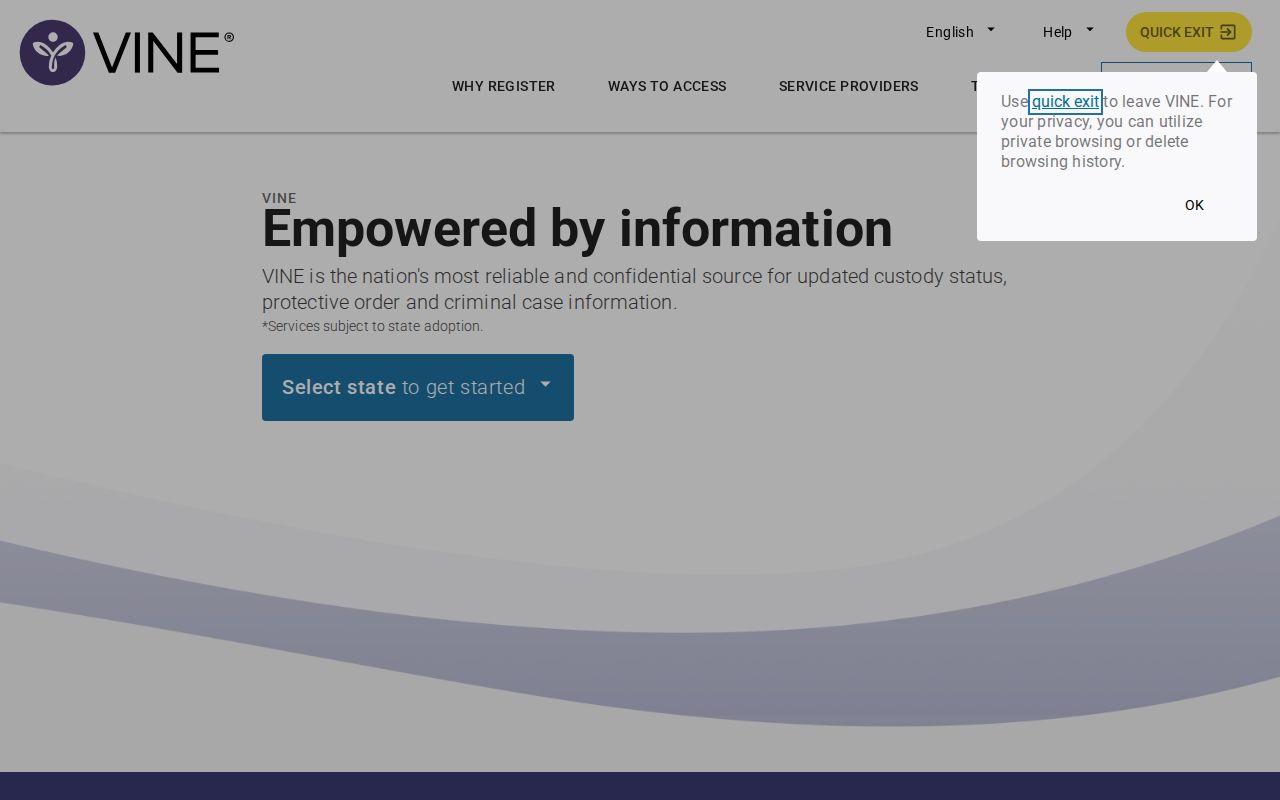
Protected registration details are separate from the public custody fields used to identify the correct record.
Federal Release Records in Illinois
Federal prison records require the BOP locator, generally for records from 1982 forward. A past release date with no facility, or a location of `RELEASED`, means BOP custody ended. It does not prove the person left every justice system. ICE ODLS is for current ICE custody or CBP custody beyond its stated window, not Illinois jail or prison release history. A failed ICE search does not prove release.
The BOP inmate locator provides identifier and name search routes for federal custody records.
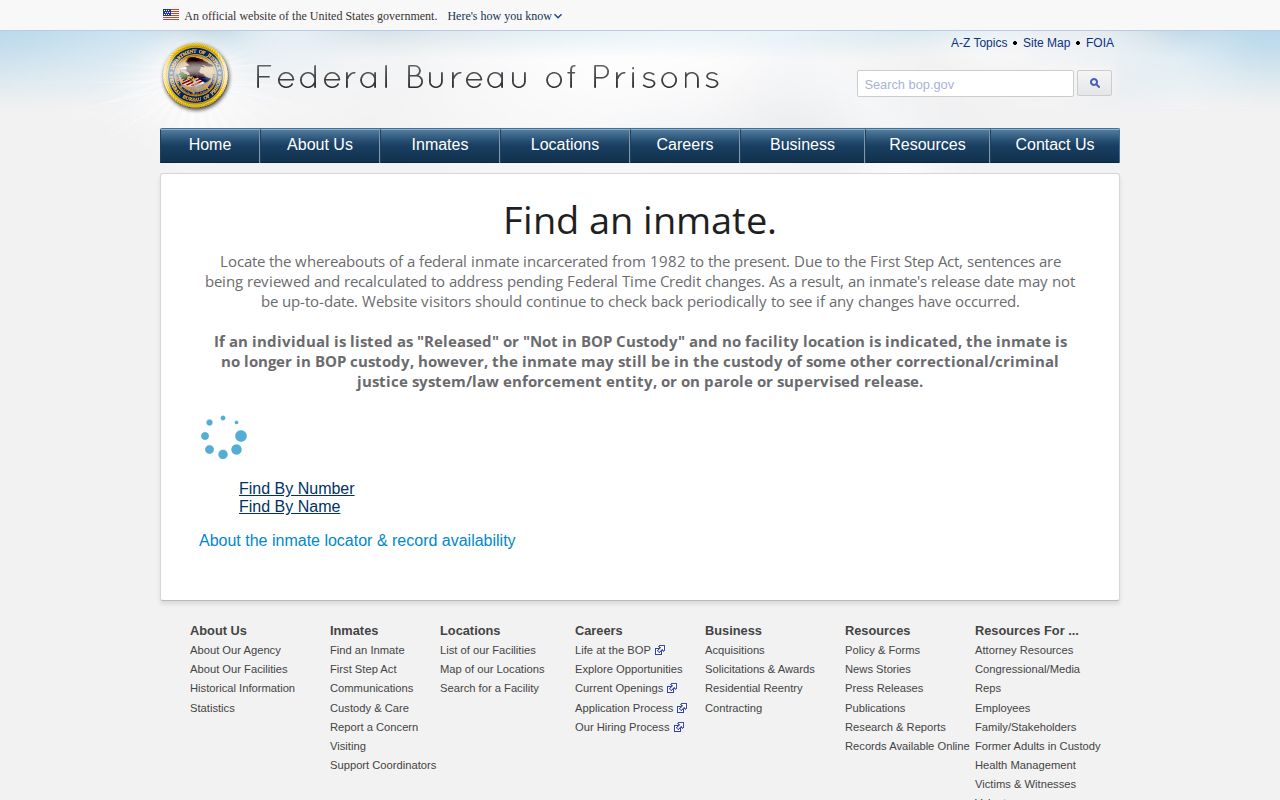
Future BOP dates remain projections, while a past date and released location address only the federal custody record.
Illinois Release Court Records
Statewide court branding does not yet equal a complete public trial-court name index for all 102 counties. Free public re:SearchIL access began in 2025 for qualifying nonconfidential Supreme and Appellate Court documents filed after the announced start point. The Illinois Supreme Court described statewide trial-court public access as later work. Local criminal release orders and dispositions still call for the official Find Your Court route and the correct Circuit Clerk.
Remote access can also be narrower than courthouse access. Restricted, sealed, expunged, impounded, and confidential records are excluded under the Remote Access Policy. If an online search is blank, check the correct county, confirm spelling and case number, and ask the clerk what nonconfidential record is available. Obtain an official or certified copy when the exact court action matters.
The Illinois Courts entry point provides statewide court navigation and access to local-court routing.
The court source can confirm why custody changed, while a jail or IDOC record supplies the agency's actual release event.
Illinois Release Image Corrections
Illinois does not impose an across-the-board ban on publication of government booking photographs. The narrower rule in 815 ILCS 505/2QQQ targets soliciting or accepting a fee to remove, correct, or modify published criminal-record information. Its covered material includes arrest, charge, and disposition descriptions, criminal-justice photographs, and identifying data, subject to the law's exclusions.
A covered for-profit publisher that charges for removal or correction must correct an error within five business days after notice. After a documented certified-mail demand, failure can support the law's stated daily remedy and attorney fees. That rule should not be recast as a promise that every image will vanish, as a ban on official publication, or as a substitute for sealing or expungement. For an error in an agency record, use that agency's correction process and preserve the supporting court or release document.